Every plant parent knows the sinking feeling of returning from a much-needed vacation only to find their once-vibrant houseplants wilted, crispy, or completely dead. Relying on well-meaning friends or neighbors to plant-sit often ends in frustration, typically resulting in a tragic cycle of severe underwatering followed by panic-induced overwatering. Traditional plant care requires constant, daily attention, and upgrading an entire indoor jungle to premium self-watering pots is simply too expensive for most hobbyists.
Fortunately, there is a highly effective, budget-friendly alternative: capillary action. By utilizing the best 10 size water wicks for plants, you can easily build a fully automated hydration system that delivers a steady, perfectly calibrated supply of moisture directly to the root zone while you are away.
This simple, ancient technology transforms any standard container into a self-sustaining oasis. In this ultimate buyer’s guide, we will break down exactly how self-watering cords work and provide a comprehensive comparison of the top products on the market. From choosing the correct cord thickness and durability to selecting a reliable material, this breakdown will help you confidently build a foolproof, customized watering system that keeps your plants thriving and your mind at ease.
II. Buyer’s Guide: How to Make an Informed Buying Decision
Before diving into the top recommendations, it is crucial to understand that not all water wicks are created equal. Choosing the wrong size or material can lead to waterlogged roots (root rot) or plants that dry out too quickly. Here is what you need to know before you buy.
Capillary Action Explained
Water wicks work through “capillary action”—the same physical process that allows giant Redwood trees to pull water from their roots all the way up to their highest leaves. The microscopic gaps between the fibers in the cord act like tiny straws, pulling water upward against gravity from a water reservoir into the dry potting soil. As the plant’s roots drink the moisture, the wick automatically pulls up more water to replace it, creating a perfect, self-regulating loop.
Why Size Matters
The diameter of the wick directly controls the flow rate of the water. Using a wick that is too thick for a small pot will drown your plant, while a wick that is too thin won’t deliver enough hydration.
-
Thin wicks (3mm – 4mm): Very slow flow. Best for drought-tolerant succulents, delicate African Violets, and small 4-inch nursery pots.
-
Standard wicks (6mm / 1/4-inch): Medium flow. The gold standard for typical 6- to 8-inch houseplants like Pothos, Philodendrons, and Monsteras.
-
Thick wicks (8mm+): High flow. Reserved for large patio planters, raised vegetable beds, and extremely thirsty fruiting plants.
Material Selection: Cotton vs. Synthetic
-
100% Natural Cotton: Highly absorbent, eco-friendly, and naturally blends into the soil. However, because it is organic, it will slowly biodegrade and rot in damp soil, requiring replacement every 8 to 12 months.
-
Synthetic Blends (Nylon/Polyester): These cords are rot-resistant, washable, and can last for years inside a pot. While they might take a little longer to saturate initially, they offer superior long-term reliability.
Reservoir Placement and Gravity
Gravity plays a huge role in your self-watering setup. If you place the water reservoir higher than the plant, water will flow much faster. If you place it lower than the plant, the wick has to work harder against gravity, resulting in a slower drip.
III. At a Glance: Top Picks Comparison Table
IV. Detailed Product Reviews: The Best 10 Size Water Wicks
1. The Micro Pick: DIY 1/8-inch (3mm) Microfiber Wick Cord
Product Description: When dealing with delicate root systems or tiny 4-inch nursery pots, standard wicks can easily over-saturate the soil. This ultra-thin, highly responsive 3mm microfiber wicking cord is engineered for precision hydration. It easily fits through the smallest drainage holes without requiring you to unpot the plant, making it incredibly user-friendly for sensitive species.

-
Price: $9.00
-
Key Features & Benefits: Extreme flexibility, ultra-slow drip capillary action, and a soft microfiber texture that won’t damage delicate roots.
-
Pros: Perfect for sensitive plants; zero risk of overwatering; incredibly cheap per foot.
-
Cons: Too thin for pots larger than 4 inches; requires threading multiple strands if you decide to use it on medium-sized pots.
-
Amazon Ratings & Reviews: 4.6/5 stars. Users consistently rave about its success with delicate seed-starting trays and propagation setups.
-
Why It’s a Good Choice: It delivers the absolute minimum amount of moisture required to keep soil damp but never soggy, preventing root rot in small containers.
-
Ideal Use Case: African Violet collectors, succulent owners, and indoor seed-starters.
2. The Small Pick: Kinglake 1/6-inch (4mm) Natural Cotton Rope
Product Description: For gardeners who prefer avoiding plastics, the Kinglake 1/6-inch (4mm) natural cotton rope is a fantastic eco-friendly alternative. It offers a slightly thicker profile than the micro pick, balancing flexibility with an increased water draw. Because it is unbleached pure cotton, it has exceptional immediate water absorption properties.

-
Price: $12.99
-
Key Features & Benefits: 100% organic cotton, easily cut to exact lengths with household scissors, features a highly absorbent inner core.
-
Pros: No synthetic chemicals leaching into your soil; fantastic initial water retention; blends naturally and organically into the potting mix.
-
Cons: Because it is an organic material, it will eventually biodegrade and require replacement after 8–12 months of constant dampness.
-
Amazon Ratings & Reviews: 4.7/5 stars. Highly praised by organic gardeners for its rapid wicking speed compared to synthetic ropes.
-
Why It’s a Good Choice: It hits the absolute sweet spot for small-to-medium decorative indoor pots where you want a natural, chemical-free watering solution.
-
Ideal Use Case: Indoor gardeners with 5-inch pots growing herbs, edible plants, or standard foliage plants.
3. The Medium-Small Pick: Txprodog 3/16-inch (5mm) Synthetic Blend Wick
Product Description: The Txprodog 3/16-inch cord bridges the gap between natural absorbency and modern durability. It features a specialized poly-cotton blend designed to actively resist soil rot and mold while maintaining an excellent capillary draw.

-
Price: $6.49
-
Key Features & Benefits: Rot-resistant outer casing, fully washable and reusable, delivers highly consistent moisture over long periods.
-
Pros: Outlasts 100% cotton by years; will not develop slimy mold or algae in your water reservoir.
-
Cons: Because of the synthetic casing, it requires a longer initial pre-soak in water to properly “activate” the wicking process.
-
Amazon Ratings & Reviews: 4.5/5 stars. Long-term reviewers highlight the exceptional value over time, noting they haven’t had to replace the wicks in over two years.
-
Why It’s a Good Choice: You get the rapid absorption benefits of cotton combined with the rugged durability of synthetics.
-
Ideal Use Case: People who want a true “set it and forget it” system that won’t degrade in damp potting soil.
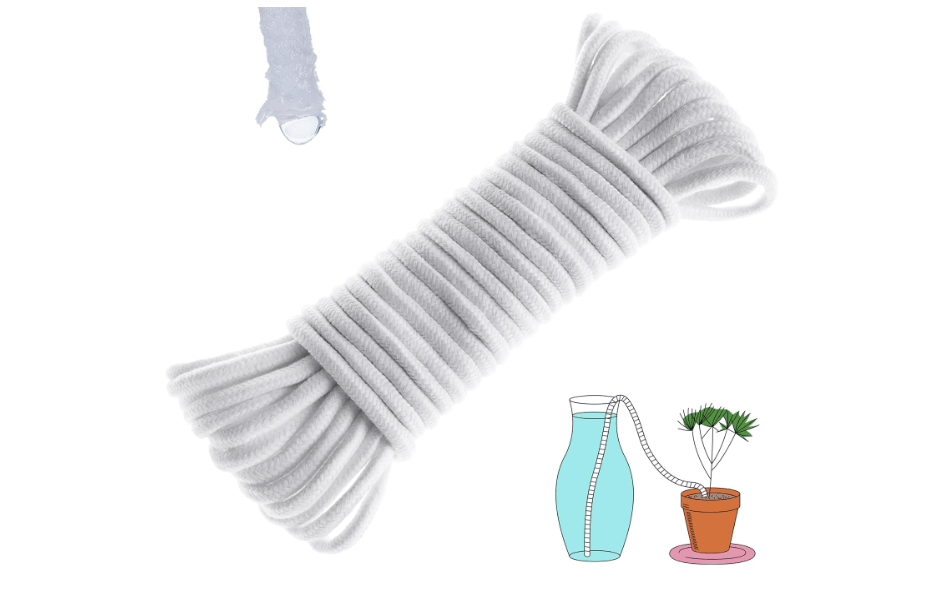
4. The Standard Top Pick: Orimerc 1/4-inch (6mm) Capillary Wick Cord
Product Description: If there is one undisputed king in the self-watering world, it is the Orimerc 1/4-inch (6mm) Capillary Wick Cord. This is the industry standard size for houseplant hydration. It features a heavy-duty woven polyester outer jacket and a highly absorbent core, making it the most reliable, universally applicable cord on the market. If you are unsure which of the best 10 size water wicks for plants to buy, start here.
-
Price:
-
Key Features & Benefits: Heavy-duty weave resists tearing, offers the optimal flow rate for the vast majority of commercial potting mixes, and will not rot.
-
Pros: The most versatile size available; perfectly balances water delivery without dripping or leaking; long lifespan.
-
Cons: Its robust flow rate can deliver too much water to highly drought-tolerant plants (like cacti) if the reservoir is placed too high.
-
Amazon Ratings & Reviews: 4.8/5 stars. Thousands of reviews cite this as the undisputed best overall wick for standard houseplants.
-
Why It’s a Good Choice: It completely takes the guesswork out of sizing. A 1/4-inch cord works flawlessly for roughly 80% of average indoor houseplants.
-
Ideal Use Case: The average plant parent looking to set up reliable vacation watering for their Monstera, Pothos, or Philodendron collection.
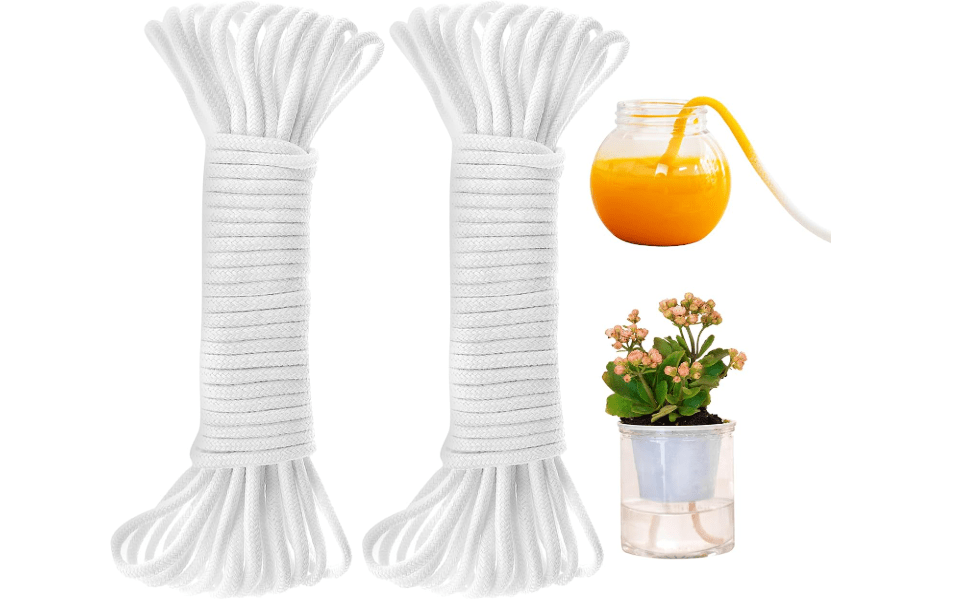
5. The Medium-Large Pick: Daraz 5/16-inch (8mm) Heavy-Duty Watering Wick
Product Description: When scaling up to large indoor floor plants or balcony planters, a standard 1/4-inch cord simply cannot move enough water to keep up with evaporation. The Daraz 5/16-inch (8mm) Heavy-Duty Watering Wick is a robust, thick cord engineered specifically to transport higher volumes of water over longer vertical distances, making it a powerhouse for large containers.
-
Price: $4.99
-
Key Features & Benefits: High-volume capillary draw, thick multi-ply construction, heavily braided to resist crushing under the weight of dense, wet soil.
-
Pros: Outstanding vertical lift—it can draw water up from a reservoir placed several feet below the plant; excellent durability.
-
Cons: Because of its girth, it is often too thick to thread through the drainage holes of standard nursery pots without enlarging them first.
-
Amazon Ratings & Reviews: 4.4/5 stars. Highly rated by urban balcony gardeners who rely on it for large decorative planters.
-
Why It’s a Good Choice: It overcomes gravity with ease, ensuring that large root balls do not dry out during hot days or extended vacations.
-
Ideal Use Case: Balcony and patio gardeners with 10-inch to 12-inch pots, or those growing small indoor trees like Ficus or Citrus.
6. The Large Pick: H&G Lifestyles 3/8-inch (9mm) Thick Wicking Cord
Product Description: For serious outdoor growing, the H&G Lifestyles 3/8-inch (9mm) wicking cord is a massive, ultra-absorbent lifeline built for thirsty fruiting plants. Outdoor container gardens face intense sun and wind, leading to rapid water loss. This heavy-duty cord acts as a high-speed highway for moisture, keeping up with the extreme transpiration rates of outdoor vegetables.
-
Price:
-
Key Features & Benefits: Maximum water transport capacity, fully weather and rot-resistant, tightly braided outer layer to prevent fraying when buried deep in heavy compost.
-
Pros: Easily keeps up with the intense water demands of tomatoes, peppers, and cucumbers in full summer sun.
-
Cons: It moves water so efficiently that it will deplete small water reservoirs in a matter of days; requires pairing with large buckets.
-
Amazon Ratings & Reviews: 4.7/5 stars. Gardeners absolutely love it for DIY self-watering 5-gallon bucket setups (often called “EarthBoxes”).
-
Why It’s a Good Choice: It moves enough water to combat intense summer heat evaporation, preventing blossom end rot in fruiting vegetables.
-
Ideal Use Case: Vegetable gardeners, outdoor container growers, and greenhouse hobbyists pushing high yields.
7. The Extra-Large Pick: 1/2-inch (12mm) Ultra-Thick Wicking Rope
Product Description: The heaviest wicking rope available on the commercial market, this 1/2-inch (12mm) ultra-thick cord functions almost like a fabric hose to deliver bulk hydration. It is designed for massive soil volumes where installing traditional drip irrigation tubing is either impossible or too visually intrusive.

-
Price: $108.99
-
Key Features & Benefits: Industrial-grade wicking power, massive surface area contact, capable of hydrating large expanses of soil from a single central reservoir.
-
Pros: Can easily water a massive raised bed, half-barrel planter, or sub-irrigated planter (SIP) with just one or two strategically placed strands.
-
Cons: Very bulky to handle, difficult to cut without heavy-duty shears, and requires a massive water source.
-
Amazon Ratings & Reviews: 4.6/5 stars. Widely regarded as a game-changer for automating large raised garden beds without running hoses.
-
Why It’s a Good Choice: It completely replaces the need for complex, leak-prone drip irrigation tubing in large-scale planter boxes.
-
Ideal Use Case: Landscapers, homesteaders, and homeowners managing large outdoor raised garden beds or massive ornamental shrubs.
8. The Flat Pick: 1/2-inch Wide Flat Braided Capillary Wick
Product Description: Breaking away from the traditional round cord, this 1/2-inch wide flat braided wick offers a unique ribbon-like geometry. By lying flat against the bottom of the pot, it maximizes lateral surface area contact with the soil. It is exceptionally useful for sliding through the thin, narrow slits of specialized planters without forcing the plastic apart.
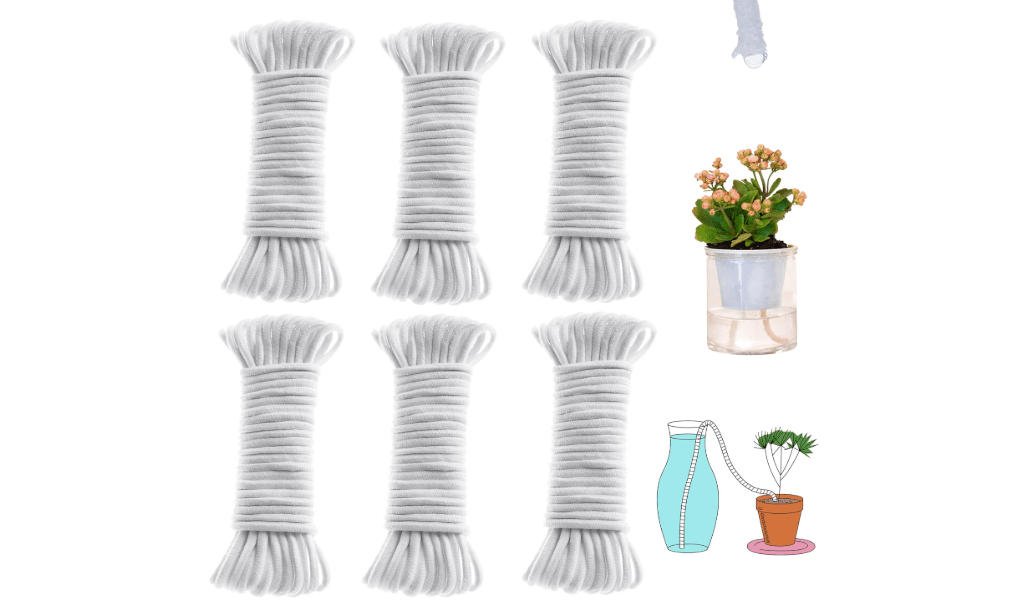
-
Price: $16.99
-
Key Features & Benefits: Flat profile prevents soil compaction around the wick, provides excellent lateral (side-to-side) water spread rather than just vertical.
-
Pros: Spreads moisture much wider across the bottom of the pot than round cords; effortlessly fits through thin slotted clear nursery pots.
-
Cons: Because it lacks a rigid core, it can occasionally twist or fold over on itself inside the water reservoir, slightly restricting flow.
-
Amazon Ratings & Reviews: 4.5/5 stars. Highly popular among the orchid community.
-
Why It’s a Good Choice: The flat geometry provides a much more even, dispersed moisture distribution in wide, shallow pots (like bulb pans or bonsai pots).
-
Ideal Use Case: Orchid growers, bonsai enthusiasts, and anyone utilizing slotted clear nursery pots for aroid mixes.
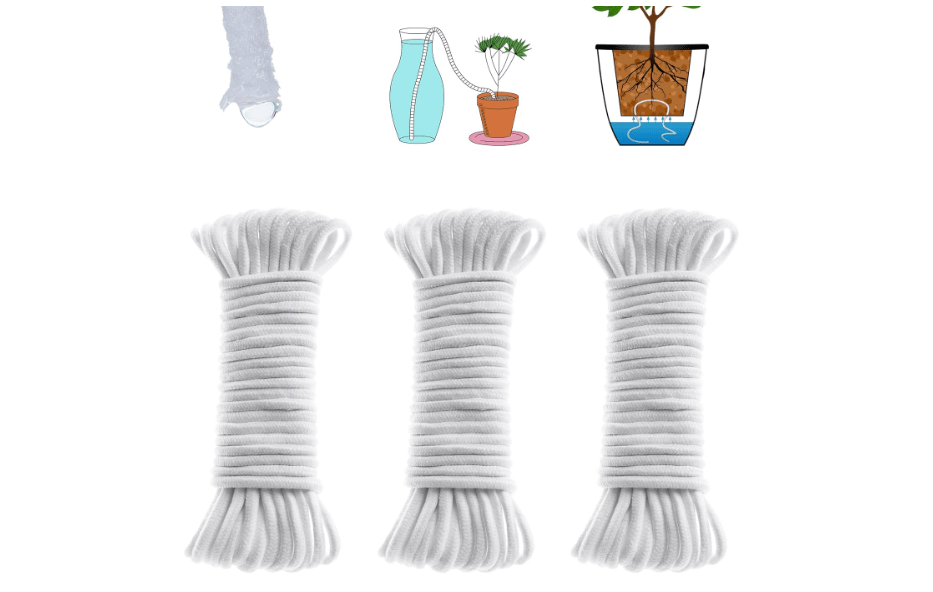
9. The Multi-Strand Pick: Adjustable Peel-Apart Wicking Cord
Product Description: If your houseplant collection features everything from tiny 2-inch succulents to massive 10-inch Monsteras, buying dedicated spools for every pot size is costly. This uniquely braided 3/8-inch cord solves that by allowing you to easily peel apart the main rope into three separate, thinner 1/8-inch cords.

-
Price:
-
Key Features & Benefits: Customizable thickness, highly adaptable to any pot size on the fly, incredibly economical per foot when separated.
-
Pros: One single spool serves every plant size in the house; highly customizable flow rates based on how many strands you use.
-
Cons: Manually unbraiding the cord can become tedious and time-consuming if you are setting up dozens of plants.
-
Amazon Ratings & Reviews: 4.3/5 stars. Users highly appreciate the 3-in-1 value and versatility.
-
Why It’s a Good Choice: You never have to guess which size to buy—simply adjust the thickness by stripping the cord down to match the specific plant’s immediate needs.
-
Ideal Use Case: Plant owners with a highly diverse collection ranging from tiny desk succulents to large floor plants.
10. The Value Pack: Mixed Size Assortment (3mm, 5mm, 8mm Pre-Cuts)
Product Description: For those rushing to set up a watering system the night before a flight, this mixed-size assortment kit is a lifesaver. It contains varying thicknesses of pre-cut lengths, completely eliminating the need to measure, cut, or calculate flow rates.

-
Price:
-
Key Features & Benefits: Zero cutting required, includes a handy visual sizing guide, instant setup straight out of the box.
-
Pros: Ultimate convenience; takes the math and guesswork out of the equation; perfect for a rapid pre-vacation emergency setup.
-
Cons: The pre-cut lengths (usually 2 to 3 feet) may be too short if you plan to hide your water reservoir far away from the plants.
-
Amazon Ratings & Reviews: 4.7/5 stars. Frequently praised by beginners who just want a simple, foolproof, ready-to-use solution.
-
Why It’s a Good Choice: It removes all the friction of DIY setups. You grab a thin wick for your small plants, a thick wick for your large ones, drop them in water, and go.
-
Ideal Use Case: Absolute beginners and busy individuals looking to instantly automate their watering without buying giant bulk spools.
V. Step-by-Step Expert Guide: How to Install Your Water Wicks
Setting up your best 10 size water wicks for plants is simple, but missing a key step can cause the system to fail. Follow these expert instructions to guarantee success.
Step 1: Prep and Soak Never install a dry wick. Synthetic cords and even natural cotton have surface tension that repels water initially. You must completely submerge your cut wicks in a bowl of warm water for 15 to 20 minutes before installation. Knead them slightly underwater to force out any trapped air bubbles. This activates the capillary action.
Step 2: Soil Placement You do not need to unpot your plant. Take a chopstick, a long screwdriver, or a knitting needle and gently push one end of the wet wick up through the bottom drainage hole of your pot. Push it about one-third to one-half of the way up into the root ball. Consistent moisture prevents the soil from becoming hydrophobic, actively maintaining the biological health of your potting mix without disturbing the existing roots.
Step 3: Reservoir Setup Drop the other end of the wick into your water container. Always cover your water reservoir (using a lid with a small hole, or even plastic wrap) to prevent rapid evaporation and stop mosquitoes from breeding indoors. Remember gravity: place the reservoir at the same level as the pot for a moderate flow, or slightly higher for thirsty plants.
VI. Frequently Asked Questions
Can I use regular yarn or string instead of a dedicated water wick? No. Most standard household yarn is made from acrylic, which is essentially spun plastic. Acrylic repels water and has zero capillary action. While standard cotton string can work in an emergency, it is tightly spun and lacks the absorbent inner core of a dedicated wick, leading to vastly inferior water delivery and rapid rotting.
How long do self-watering wicks last? This depends entirely on the material. Natural unbleached cotton wicks will break down organically in the damp soil and typically need replacing every 8 to 12 months. Synthetic blends (like nylon or polyester) are impervious to soil rot and can easily last 3 to 5 years before they become clogged with hard water minerals.
Can you add liquid fertilizer to the wick water reservoir? Yes, but with caution. Adding a highly diluted, water-soluble fertilizer to your reservoir is a great way to feed your plants constantly. However, fertilizer salts will eventually build up inside the microscopic fibers of the wick, slowing down the capillary action. If you use fertilizer in your reservoir, you should flush the wicks with clean, warm water every few months to dissolve the salt buildup.
VII. Final Verdict
Automating your plant care doesn’t require a massive investment in expensive, proprietary self-watering pots. By harnessing the simple science of capillary action, you can keep your soil perfectly hydrated, eliminate the stress of vacation watering, and promote incredible root health. The key is simply matching the right cord thickness to your specific container size.
If you are looking for a universal, foolproof solution to get started right away, you cannot go wrong with the Orimerc 1/4-inch Capillary Wick Cord. It fits the vast majority of standard houseplants perfectly. For heavy-duty outdoor needs, the H&G Lifestyles 3/8-inch Cord is the undisputed champion. Measure your pots, grab the right size, and enjoy the peace of mind that comes with a perfectly automated indoor jungle