
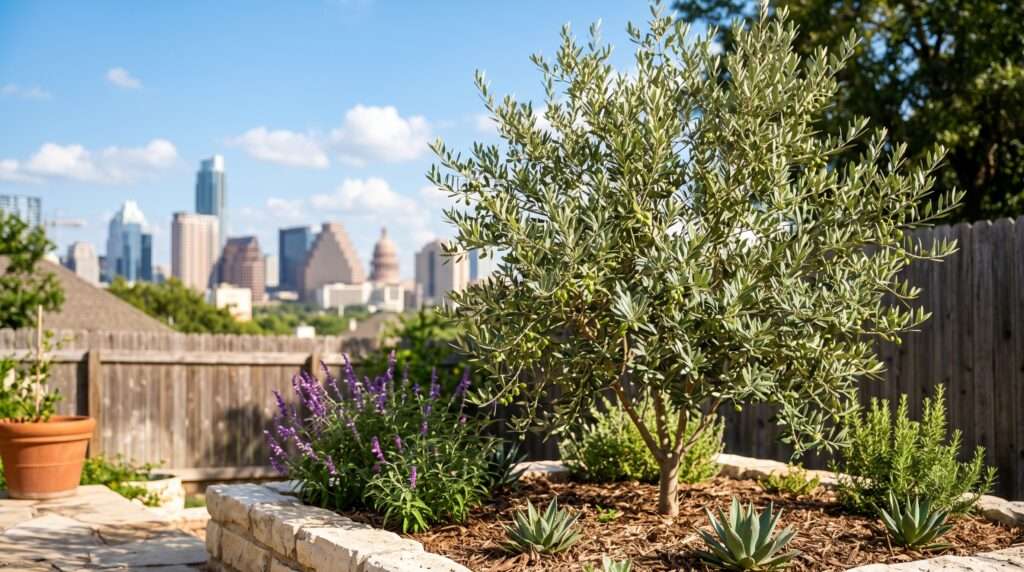
Imagine stepping into your Central Texas backyard, sipping iced tea under the elegant, silvery-green canopy of a Mediterranean classic. It sounds like an idyllic Tuscan dream, but then reality hits: brutal 105°F August afternoons, sudden February ice storms, and ground so hard it bends your shovel. If you are wondering how to successfully cultivate and grow olive trees in austin, you are in exactly the right place.
Olive trees absolutely love the heat, but Austin’s famous bipolar weather—extreme heat followed by sudden deep freezes—combined with heavy clay and rocky limestone soils, can turn into a tree-killer if not managed properly.
As a local gardening expert, I’ve seen countless gardeners plant a beautiful olive tree only to watch it succumb to root rot or winter frostbite. But here is the good news: growing these majestic trees in Central Texas is entirely possible, highly rewarding, and easier than you might think once you understand their specific needs. In this comprehensive guide, we will break down exactly how to choose the right cold-hardy variety, prep our notoriously tricky Texas soil, and protect your investment when the winter frost rolls in. Let’s dig in! ✨🫒
☀️ Can You Really Grow Olive Trees in Austin, Texas?
The short answer is: Yes, absolutely! However, you cannot treat them like a native Texas live oak or a thirsty tropical plant.
Austin falls predominantly into USDA Hardiness Zones 8b and 9a. This actually gives us a semi-arid, Mediterranean-leaning climate that olive trees (Olea europaea) naturally adore. They thrive in long, hot, dry summers and appreciate cool, mild winters.
The “Chill Hour” Advantage 🥶
If you want your olive tree to produce those beautiful little green and black fruits, the tree needs something called “chill hours.” Most fruiting olive varieties require between 150 and 400 chill hours (hours where the temperature drops between 32°F and 45°F during the winter) to set blossoms in the spring. Austin’s winters easily provide this natural chill requirement, giving us a distinct advantage over tropical climates where olives will grow but never fruit.
The Catch: Wet Feet and Sudden Freezes 🧊
While the climate is mostly a match, you have to protect your tree from Central Texas’s two biggest threats:
-
“Wet Feet”: Olive trees are incredibly drought-tolerant, but they despise sitting in waterlogged soil. In poorly draining dirt, their roots will suffocate and develop fungal root rot.
-
Sudden Extreme Cold: While they like cool winters, sudden drops into the teens (like the infamous Winter Uri) can severely damage or kill a young tree.
By understanding these two factors, you are already halfway to becoming a successful Texas olive grower!
🫒 The Best Cold-Hardy Olive Tree Varieties for Central Texas
Not all olive trees are created equal. Walking into a big-box nursery and buying whatever generic olive tree they have on sale is a recipe for heartbreak. To succeed in Austin, you must choose varieties bred for cold tolerance.
Here is a quick breakdown of the best cultivars for our specific microclimate:
1. Arbequina: The Texas Champion 🏆
If you only plant one olive tree in Austin, make it an Arbequina. Originating from Spain, this variety is the undisputed king of Texas olive orchards. It is incredibly tough, tolerating temperatures down to 15°F once established. Arbequinas are self-pollinating (meaning you only need one tree to get fruit), compact enough for smaller urban yards, and produce small, highly concentrated olives that make exquisite, buttery olive oil.
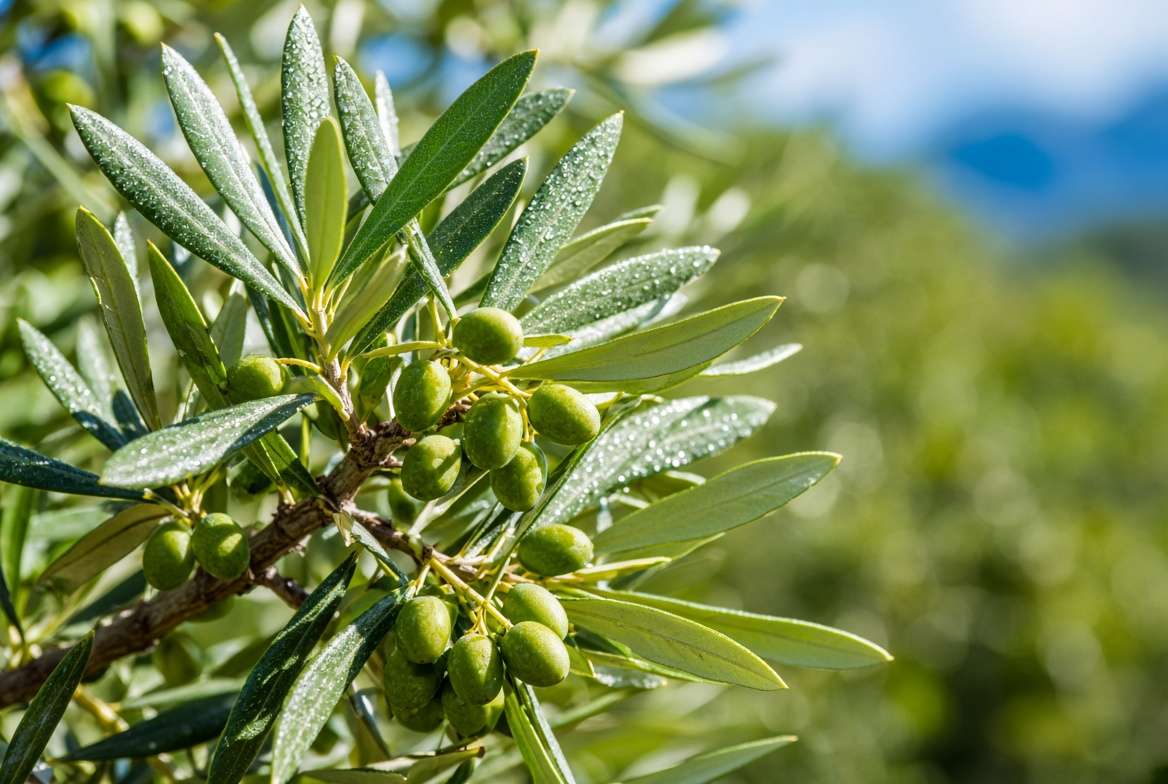
2. Mission: The American Classic
Developed in California by Spanish missionaries, the Mission olive is a vigorous, upright grower that can get quite tall. It shares the Arbequina’s excellent cold hardiness (around 15°F) and is incredibly resilient against the strong winds that often whip through the Hill Country. Mission olives are dual-purpose, meaning they are equally fantastic cured for a charcuterie board or pressed into oil.
3. Picual & Koroneiki: The Heat Lovers
If your yard gets absolutely baked by the western afternoon sun, consider a Picual or Koroneiki. Picual hails from Andalusia, Spain, and laughs in the face of 105°F August days. Koroneiki, a Greek variety, is highly prized for producing robust, peppery oil. Note: Both of these are slightly less cold-hardy than Arbequina, so they will require a bit more winter protection during a hard Texas freeze.
Expert Tip: While varieties like Arbequina are self-fruitful, olive trees are wind-pollinated. Planting two different varieties relatively close to each other will significantly increase your fruit yield through cross-pollination! 🌬️🫒
⛏️ Planting Your Olive Tree: Beating Austin’s Tricky Soil
If there is one thing that unites all Austin gardeners, it is a shared disdain for the soil. Depending on exactly where you live in the metro area, you are likely dealing with one of two extremes.
The Edwards Plateau Limestone vs. Blackland Prairie Clay 🪨
If you live west of I-35 (Westlake, Lakeway, the Hill Country), you are planting in shallow, highly alkaline soil resting on top of solid limestone caliche. If you live east of I-35 (Pflugerville, Manor, East Austin), you are dealing with Blackland Prairie clay—thick, sticky, heavy soil that turns into a swamp when it rains and cracks like concrete during a drought.
Olive trees demand excellent, rapid drainage. If you just dig a hole in East Austin clay and drop your tree in, you are essentially planting it in a waterproof clay bathtub. It will drown.

How to Prep the Soil for Success
To overcome Austin’s soil, you must amend heavily or change the planting elevation:
-
The Drainage Test: Before planting, dig a hole 2 feet deep and fill it with water. If the water hasn’t completely drained within 2 to 3 hours, your drainage is too poor for an olive tree.
-
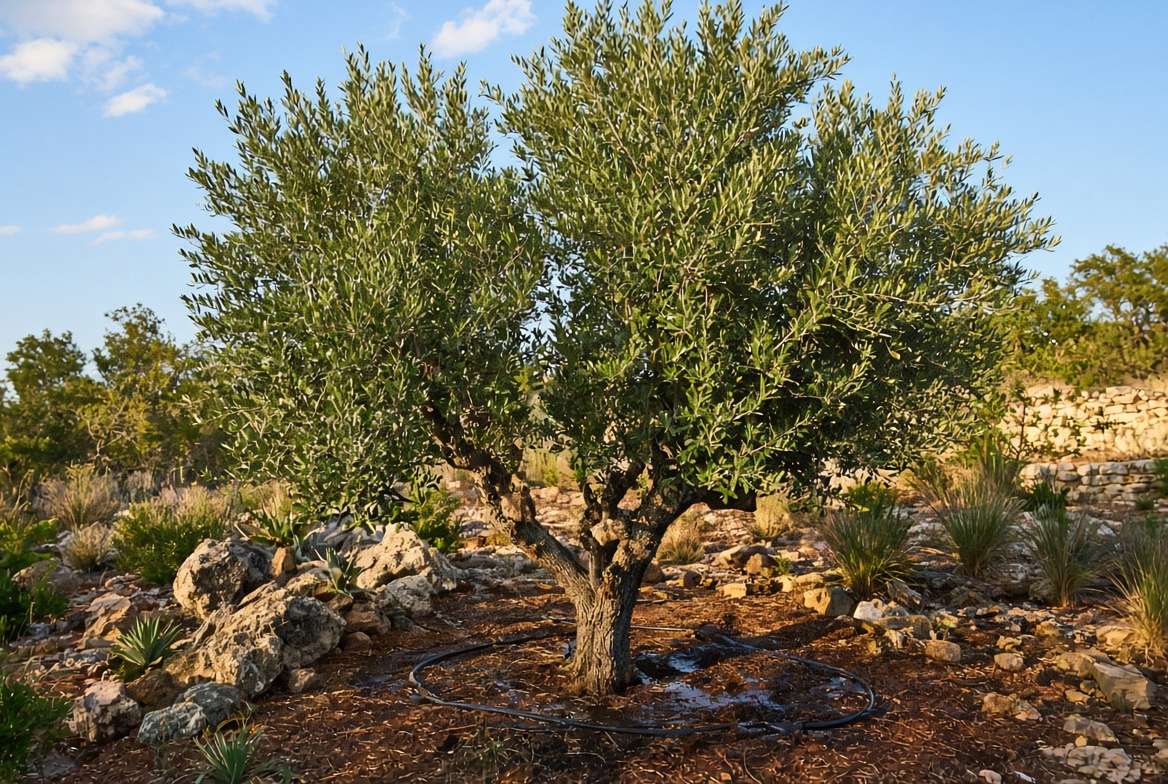
Plant on a Berm or Raised Bed: The absolute best way to ensure your olive tree survives in heavy clay is to plant it slightly above the native grade. Build a gentle mound (a berm) about 12 to 18 inches high using a well-draining soil mix, and plant your tree in that.
-
The Texas Olive Soil Mix: To create the perfect drainage, mix native soil with generous amounts of expanded shale (a natural Texas clay product fired in a kiln that breaks up heavy clay), decomposed granite, and a high-quality organic compost. Do not use peat moss, as it holds onto too much water.
Sunlight Requirements 🌞
When scouting a location for your tree, remember this rule: There is no such thing as too much sun for an olive tree in Texas. Your tree needs a minimum of 6 to 8 hours of direct, blasting, full sunlight every single day. Do not plant it under the shade of a mature Live Oak or Pecan tree. Plant it where it will get baked by the southern or western sun. The more sun it gets, the denser the foliage will grow and the more fruit it will produce.
💧 Watering and Feeding: Thriving in the Texas Heat
Once your tree is safely in the ground, managing its water and nutrient intake is the next hurdle. While mature Mediterranean plants are famously drought-tolerant, a newly planted tree in the middle of a Texas summer is highly vulnerable.
Watering Rules for the First Year vs. Established Trees 🚿
During its first year in your Austin garden, your olive tree’s root system is shallow and still establishing itself. Through the scorching months of June, July, and August, you will need to water it deeply 1 to 2 times a week. The goal is to keep the soil consistently moist but never soggy.
Once established (after 2 to 3 years), olive trees become incredible water-misers. At this stage, you should switch to deep, infrequent watering. Soaking the root zone heavily every two to three weeks during dry spells is far better than giving it a light sprinkle every day. Deep watering encourages the roots to drive downward, protecting them from surface heat and increasing their drought resilience.
Fertilizing Dos and Don’ts 🌿
Olives are not heavy feeders, but our rocky Hill Country limestone and depleted urban soils often lack vital nutrients. Feed your tree in early spring (March) as new growth begins, using a balanced, nitrogen-rich fertilizer or a specialized citrus/olive tree mix.
Crucial Warning: You must stop fertilizing your olive trees by late summer (mid-August). Applying fertilizer in the fall encourages flushes of tender, new leafy growth. This young growth hasn’t had time to harden off and will be instantly destroyed by the first Central Texas frost, severely stressing the tree.
❄️ The Ultimate Winter Survival Guide for Austin Olives
This is the make-or-break section for growing olive trees in Austin. While varieties like Arbequina can survive down to 15°F, it is sudden temperature plummets—like a sunny 70°F day followed by a 18°F ice storm the next night—that cause the most damage. Preparation is everything.
Pre-Freeze Preparation 🧊
When the local meteorologist announces a hard freeze (temperatures dropping into the 20s or below), take action 48 to 72 hours in advance:
-
Water deeply: It sounds counterintuitive, but moist soil holds ambient heat much better than dry soil. Giving the root zone a deep soak a few days before a freeze actually insulates the roots.
-
Mulch heavily: Apply a thick, 3-to-4-inch layer of hardwood mulch over the entire root zone to trap warmth. Keep the mulch pulled a few inches away from the actual trunk to prevent rot.
Wrapping and Covering (The 20°F Rule) 🧣
If temperatures are forecasted to dip below 20°F, you need to cover young or unestablished trees.
-
Frost Cloth: Drape a heavy-duty frost blanket (not plastic tarp!) over the canopy, ensuring the edges reach all the way to the ground to trap the geothermal heat rising from the soil. Weigh the edges down with rocks or bricks.
-
The Christmas Light Trick: For extreme freezes, weave old-school, incandescent C9 Christmas lights (they must be incandescent, not LED, because you need the heat) through the inner branches before wrapping the tree. This simple trick can raise the ambient temperature under the frost cloth by 5 to 8 degrees—often the difference between life and death for a young tree. 🎄

Spring Recovery 🌱
If your tree suffers frostbite, the leaves will turn brown and crisp in the weeks following the freeze. Do not prune immediately. Wait until late spring (April or May) when you can clearly see where new green buds are pushing through. Once the tree shows you what is alive and what is dead, prune away the dead wood. Olive trees are incredibly resilient and can often regenerate entirely from the trunk even if the canopy is lost.
🪴 Potted vs. In-Ground: Which is Best for You?
If managing soil drainage and wrapping trees in the freezing rain sounds like too much work, container growing is a fantastic alternative for Austin residents.
Growing Olive Trees in Containers on Patios
Keeping your olive tree in a large, well-draining pot is incredibly popular in Central Texas. The massive benefit? Mobility. When a severe winter storm rolls in, you can simply wheel the tree into your garage or sunroom, completely bypassing frost protection anxiety. 🥶
For container growing, choose a compact variety like Koroneiki or Arbequina. Plant them in a high-quality cactus or citrus potting mix to guarantee rapid drainage. Potted trees will need more frequent watering and fertilizing than in-ground trees, as nutrients wash out of pots quickly.
Growing in the Landscape
Planting directly in the ground is best for long-term growth and large fruit yields. An in-ground tree will eventually become a stunning focal point in your landscaping, casting gorgeous dappled shade. It requires more upfront labor with soil prep and winter vigilance, but the architectural beauty of a mature olive tree in your yard is unmatched.
🐛 Common Pests and Problems in Central Texas
While olive trees are generally pest-resistant, our humid Austin springs can invite a few unwanted guests.
-
Scale and Aphids: These tiny sap-sucking insects can occasionally congregate on new growth. You might notice a sticky residue (honeydew) or black sooty mold on the leaves. Treat them naturally by spraying the foliage with insecticidal soap or Neem oil in the early evening. 🐞
-
Texas Root Rot (Cotton Root Rot): This is a fatal soil fungus prevalent in the alkaline soils of Central Texas. It thrives in poorly drained, warm soil. There is no cure, which is why prevention—ensuring perfect soil drainage before you plant—is absolutely mandatory.
-
Yellowing Leaves: If the older leaves are turning yellow and dropping, it is almost always a sign of overwatering or poor drainage. If the entire canopy looks pale and yellowish-green, your tree likely needs a nitrogen boost.
🧺 When & How to Harvest Your Texas Olives
If you’ve provided the right sun, water, and chill hours, your tree will reward you with fruit!
-
When to Pick: Olives start green and slowly ripen to a dark purple or black. For green olives, harvest in early fall (September/October). For black, fully ripe olives, wait until late fall or early winter.
-
A Crucial Reality Check: Do not pop a raw olive straight off the tree into your mouth! Raw olives contain oleuropein, a profoundly bitter compound. They are completely inedible until they have been properly cured (brined in salt water, water-cured, or lye-cured). Curing your own Austin-grown olives is a fun, rewarding culinary project that makes for amazing holiday gifts. 🫙

🙋♀️ Frequently Asked Questions (FAQs)
Do I need two olive trees to get fruit? Most cold-hardy varieties recommended for Austin, like the Arbequina, are self-fruitful, meaning one tree will produce olives. However, planting a second tree of a different variety nearby will increase cross-pollination and significantly boost your fruit yield.
How fast do olive trees grow in Texas? Olive trees are moderate to slow growers. In optimal Central Texas conditions with ample sun, you can expect about 1 to 2 feet of new growth per year.
Are olive trees toxic to dogs or cats? No! Olive trees are completely non-toxic and pet-safe, making them a worry-free addition to a busy backyard. 🐶🐱
✨ Bringing Your Central Texas Olive Dream to Life
Cultivating olive trees in Austin is a masterclass in working with our unique environment rather than fighting it. By selecting a cold-hardy champion like the Arbequina, elevating your planting site to conquer heavy clay, and keeping your frost blankets and Christmas lights handy for February freezes, you can absolutely bring that Mediterranean magic to the Texas Hill Country. The silvery foliage and eventual harvest of homegrown olives are well worth the effort.
If you are currently growing an olive tree in your Austin yard, or if you are planning to plant your first one this spring, share your experiences and strategies in the comments below!











