

Welcome to the urban gardening revolution! If you live in an apartment, you have probably scrolled through photos of lush, sprawling backyard harvests and felt a pang of jealousy. Root vegetables, in particular, seem entirely out of reach when your only outdoor space is a few square feet of concrete. But here is the well-kept secret of container gardening: growing carrots in deep pots for balconies is not only highly possible, but it often yields straighter, crunchier, and more beautiful carrots than traditional in-ground gardening. 🥕✨
After years of helping urban gardeners maximize their small spaces, I’ve found that root vegetables thrive in controlled environments. You don’t need a sprawling backyard or raised wooden beds. With the right container depth, a fluffy potting mix, and optimal balcony placement, you can harvest sweet, crisp homegrown carrots right outside your apartment door.
In this comprehensive guide, we will walk through the exact steps to transform your balcony into a high-yielding carrot patch, covering everything from container selection and soil science to troubleshooting urban pests. Let’s get growing! 👩🌾💚
Why Growing Carrots in Deep Pots is Actually an Advantage 🏆🥕
You might think that balcony gardening is a compromise, but when it comes to carrots, container gardening actually offers several massive advantages over traditional backyard plots.
-
Total Soil Control: The number one reason backyard gardeners harvest ugly, twisted, or “forked” carrots is heavy clay soil and hidden rocks. Carrots need a path of least resistance to grow straight down. When you fill a pot, you control 100% of the soil structure, ensuring it remains loose and rock-free.
-
Drastic Pest Reduction: Being elevated on a balcony naturally deters a whole host of ground-dwelling pests. You won’t have to worry about moles, voles, rabbits, or groundhogs treating your carrot tops like an all-you-can-eat buffet.
-
Space Efficiency: Carrots have a very small footprint above ground. Their fern-like foliage grows vertically, meaning you can densely pack a surprising number of seeds into a single pot tucked into a sunny corner of your balcony.
Choosing the Right Container: Why “Deep Pots” Matter 🪣📏
The golden rule of growing root vegetables in containers is simple: the pot must be deeper than the mature length of the vegetable. This is where most beginners fail—they use shallow window boxes and end up with stunted, golf-ball-sized carrots.
Minimum Depth Requirements for Carrots
To give the taproot enough room to stretch, you need depth.
-
For short/round varieties: Minimum of 8–10 inches deep.
-
For half-long varieties: Minimum of 12 inches deep.
-
For standard/long varieties: Minimum of 15–18 inches deep.
If you have the space, opting for a 15-inch deep pot gives you the flexibility to grow almost any type of carrot without hitting the bottom.

Best Pot Materials for Balcony Weather ☀️🌬️
Balconies have unique microclimates—they can be incredibly windy and prone to intense heat reflection from brick or concrete walls.
-
Fabric Grow Bags: My top recommendation. They are lightweight (perfect for balconies with weight restrictions), promote excellent root aeration, and prevent root circling.
-
Plastic Containers: Great for retaining moisture on hot, windy balconies, and they are lightweight. Ensure they are UV-resistant so they don’t crack mid-season.
-
Terracotta/Clay: Beautiful and heavy (won’t blow over in high winds), but they are highly porous. You will need to water them much more frequently as they dry out rapidly.
Drainage: The Non-Negotiable Rule 💧
Carrots hate “wet feet.” If water pools at the bottom of your pot, the roots will rot before they ever reach your dinner plate. Ensure your chosen container has multiple, large drainage holes.
🪴 Expert Tip Box: Avoid the “gravel at the bottom” myth! Many beginners put rocks at the bottom of pots thinking it improves drainage. Horticulture science shows this actually creates a “perched water table,” bringing the soggy soil closer to your plant roots. Instead, fill the entire pot from bottom to top with your high-quality potting mix.
The Absolute Best Carrot Varieties for Balcony Containers 🥇🌱
Not all carrots are created equal. When growing in containers, you want varieties bred for shorter taproots, fast maturation, and tight spacing. Here are the champion varieties for balcony gardeners:
1. Short and Stout Varieties (Perfect for 10-inch pots)
If you only have space for moderately deep pots, these are your best bets:
-
Danvers 126: A classic, thick carrot that powers through even slightly dense soil. It maxes out around 6-7 inches long.
-
Chantenay: Famous for its short, conical shape and sweet flavor.
-
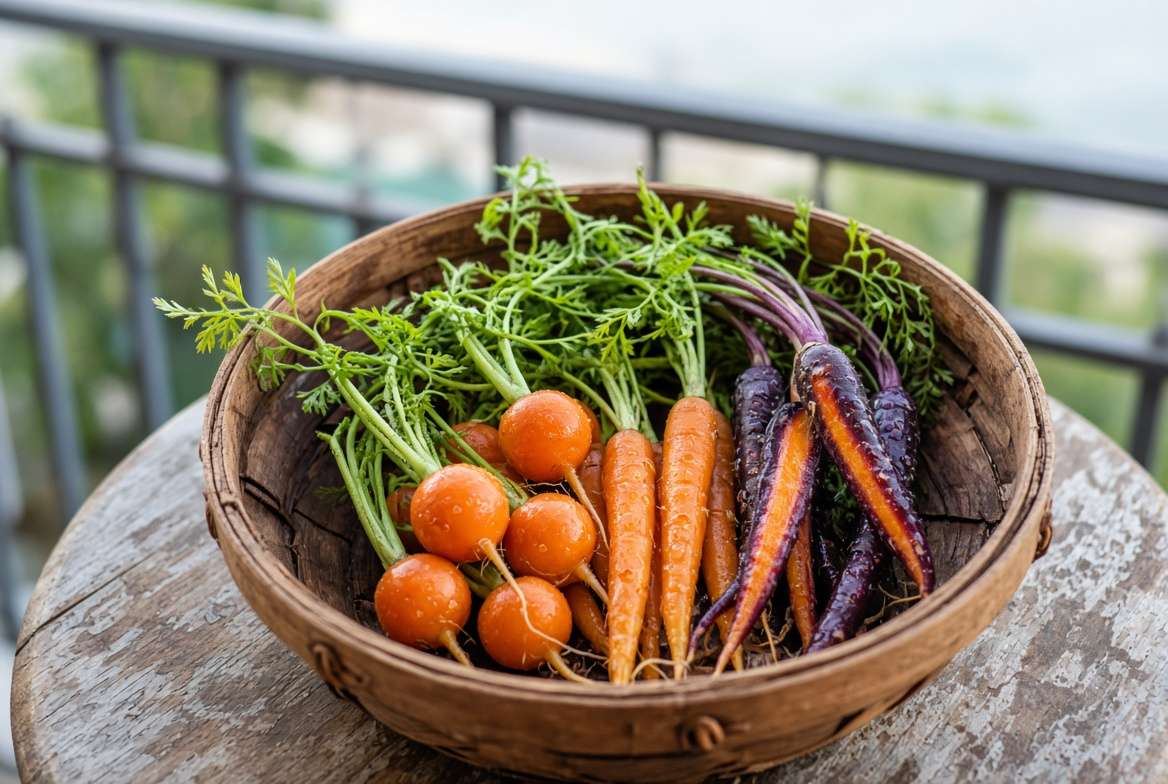
Parisian: A unique, heirloom variety that grows into round, bite-sized orange spheres (like radishes!). They need very little depth and are fantastic for shallow pots.
2. Slender and Fast-Growing (Perfect for 12-15 inch pots)
-
Little Finger: A gourmet baby carrot variety that matures quickly (about 60 days) and only grows to about 4 inches long. You can plant these quite densely.
-
Nantes: Known for being incredibly sweet, crisp, and nearly perfectly cylindrical. They grow about 6-7 inches long and thrive in container environments.
3. Fun Colors for Kids and Discoverability 🌈
Want to make your balcony garden visually stunning? Try these colorful varieties that are packed with antioxidants:
-
Cosmic Purple: Stunning purple skin with a bright orange core. It grows to about 7 inches and is incredibly sweet.
-
Atomic Red: A vibrant red carrot that gets even brighter when cooked.
Crafting the Perfect Soil Mix for Potted Carrots 🤎🔬
When growing carrots in deep pots for balconies, the growing medium you choose will make or break your harvest. Carrots are essentially a single, swollen taproot. If that root hits a roadblock, it will split, fork, or stunt.
Why Heavy Garden Soil is a Big Mistake
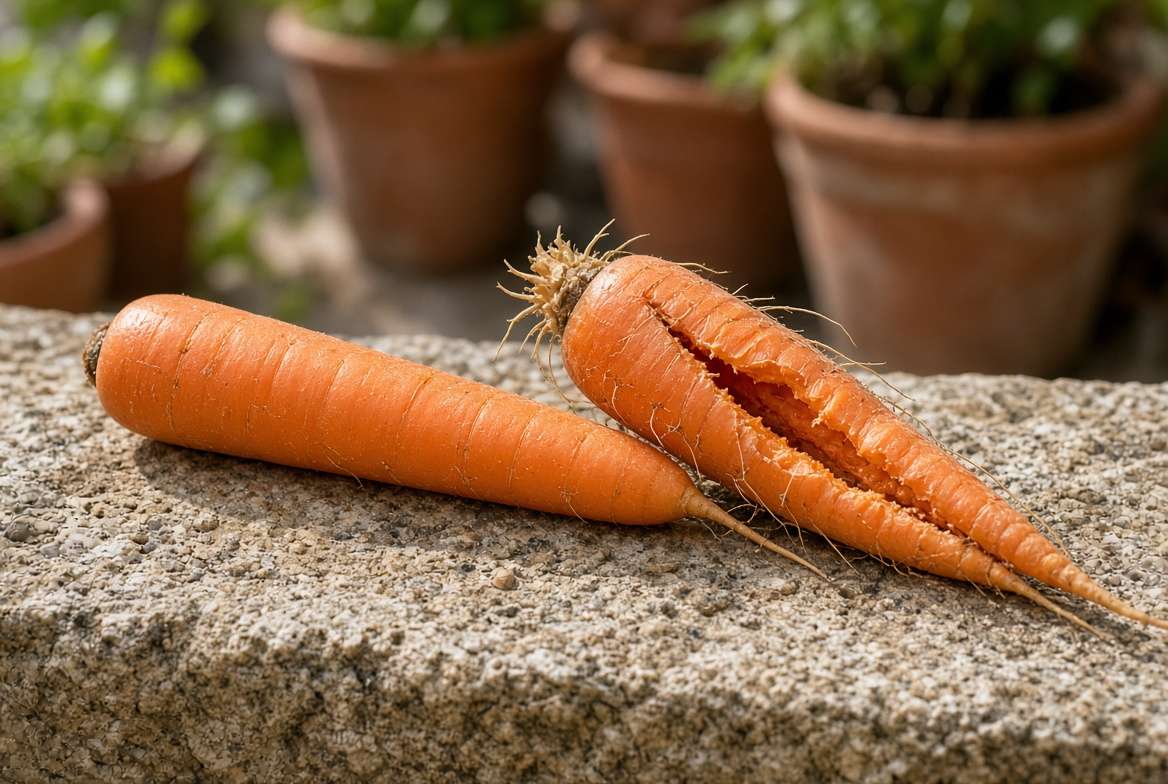
Never scoop dirt from a garden bed or buy cheap, heavy “topsoil” for your container carrots. Traditional soil compacts easily in pots, especially after repeated watering. This compaction suffocates the delicate feeder roots and creates an impenetrable barrier for the taproot. The result? Stubby, twisted, or multi-legged carrots that look like aliens!
The Ideal DIY Balcony Soil Recipe 🥣
Carrots need “friable” soil—a horticultural term meaning soil that is light, crumbly, and easily broken apart. To achieve this in a container, mix your own lightweight blend. Here is the perfect recipe for balcony root crops:
-
60% High-Quality Potting Mix: Provides the organic base and essential nutrients. Ensure it is formulated for containers.
-
30% Coco Coir or Peat Moss: This acts as a sponge, retaining essential moisture without making the soil soggy. This is critical on windy balconies where pots dry out quickly.
-
10% Perlite and coarse Sand: This adds necessary air pockets and drainage. A handful of horticultural sand ensures the soil remains incredibly loose for deep root penetration.
🧑🌾 Horticulturist Insight: Before filling your pots, ensure your soil mixture is thoroughly moist. Dry peat moss or coco coir can be hydrophobic (water-repellent) at first. Mix your soil with water in a large tub until it feels like a damp sponge before putting it into your balcony pots.
Step-by-Step Guide: Planting Carrots in Deep Pots for Balconies 📝🪴
Unlike tomatoes or peppers, you should never start carrots in seed trays to transplant later. The taproot is highly sensitive; moving a carrot seedling almost guarantees a deformed root. You must sow the seeds directly into their final deep pot on your balcony.
Sowing the Seeds Correctly
Carrot seeds are notoriously tiny—almost like specks of dust.
-
Level the Soil: Smooth out the damp soil in your pot, leaving about an inch of space from the rim to allow for watering.
-
The Broadcast Method: For pots, lightly sprinkle (or “broadcast”) the seeds across the surface of the soil. Try to space them about 1 inch apart, though perfect precision is nearly impossible.
-
Cover Lightly: Carrot seeds need light to germinate. Cover them with a very thin layer (about ¼ inch) of fine potting soil or vermiculite.
-
Mist, Don’t Pour: Use a spray bottle to mist the surface. Pouring water from a watering can will wash the tiny seeds away or bury them too deeply.
The Crucial “Thinning” Process ✂️
This is the hardest part for beginner gardeners psychologically, but it is absolutely vital.
Once your seedlings are about 2 inches tall, you will likely have a dense forest of tiny carrot tops. If you leave them crowded, they will compete for nutrients and space, resulting in tiny, stringy roots. You must “thin” them by snipping the weaker seedlings at the soil line with scissors, leaving about 2 to 3 inches of space between each remaining plant.
💡 Pro-Tip: Don’t throw the thinned seedlings away! Carrot microgreens are edible, packed with flavor, and taste exactly like a mature carrot. Toss them into your next salad! 🥗

Balcony Care: Mastering Light, Water, and Microclimates 🌤️🏙️
Urban balconies present unique environmental challenges. Managing your specific microclimate is the secret to a bumper crop.
Maximizing Sunlight on a Shaded Balcony
Carrots prefer full sun (6–8 hours of direct light daily). However, they are more forgiving than fruiting plants like tomatoes and can tolerate partial shade (4–5 hours).
-
Sun-Chasing: Place your pots on heavy-duty wheeled caddies. This allows you to easily roll your heavy, deep pots across the balcony to follow the shifting sun.
-
Reflective Surfaces: If your balcony is heavily shaded by adjacent buildings, place white boards or reflective foil behind your pots to bounce ambient light back onto the foliage.
Watering Hacks for Deep Containers 🚿
Consistent moisture is the key to sweet, uncracked carrots. If the soil goes from bone-dry to soaking wet, the sudden influx of water will cause the carrot roots to split open.
-
The Finger Test: Plunge your finger into the soil up to your second knuckle. If it feels dry, it’s time to water.
-
Deep Watering: When you water, water deeply until you see it running out the drainage holes. Light surface watering encourages shallow root systems, which is the exact opposite of what you want for a deep taproot!
Managing Wind and Balcony Microclimates 🌬️
High-rise balconies are notoriously windy, which rapidly evaporates moisture from container soil. If you use terracotta pots or fabric bags, you may need to water daily during the peak of summer. Additionally, brick walls absorb heat during the day and radiate it at night. If your carrots are getting too hot, move them away from the brick walls to prevent them from bolting (going to seed prematurely).
Fertilizing Potted Carrots for Maximum Yield 🧪🥕
Because frequent watering flushes nutrients out of container soil, your balcony carrots will need a little feeding. However, feeding root vegetables requires a specific strategy.
The N-P-K Rule for Root Veggies
When looking at organic fertilizers, you will see three numbers representing Nitrogen (N), Phosphorus (P), and Potassium (K).
-
Avoid High Nitrogen: Nitrogen promotes lush, leafy green growth. If you give carrots too much nitrogen, you will end up with magnificent bushy tops and tiny, stringy roots underneath.
-
Prioritize P and K: Phosphorus and Potassium are the minerals responsible for robust root development and overall plant health. Look for a fertilizer tailored for root crops, such as bone meal, liquid kelp extract, or a low-nitrogen tomato/vegetable feed (like a 3-4-4 blend).
When and How Often to Feed
-
First Feed: Wait until your carrots have been successfully thinned and are about 3 weeks old.
-
Maintenance: Apply a diluted liquid fertilizer every 3 to 4 weeks throughout the growing season until harvest.
Common Balcony Carrot Pests & Troubleshooting 🐛🛡️
You might think that living on the 5th floor protects your plants from bugs, but many pests can fly or travel on the wind.
Pests (Even on the High Floors!)
-
Aphids: These tiny green or black bugs cluster on the leafy greens, sucking the sap and weakening the plant. Solution: A strong blast of water from a spray bottle or a gentle application of organic Neem oil.
-
Carrot Rust Flies: These pests lay eggs in the soil, and the maggots burrow into the carrot root, leaving rusty-looking tunnels. Solution: Elevating pots on balconies naturally deters them, but if they persist, use a floating row cover over your pot during the early growth stages.
Troubleshooting: Why are my carrots… 📉
-
Small and Stubby? The soil was too heavy, the pot was too shallow, or they were not thinned properly.
-
Hairy? Excess nitrogen in the soil or overwatering.
-
Cracked or Split? Inconsistent watering (letting the pot dry out completely, then flooding it).
-
Pale or Bitter? They got too hot or didn’t receive enough sunlight. Carrots prefer cooler weather!
The Best Part: Harvesting Your Balcony Carrots 🎉🧺
Patience is key! Depending on the variety, carrots typically take anywhere from 60 to 80 days to reach maturity.
How to Know When They Are Ready
Don’t pull blindly! Use the “Shoulder Check.” Gently brush away the top half-inch of soil around the base of the green stems to reveal the “shoulder” or crown of the carrot. If it looks wide and displays a rich, vibrant color, it is ready. If it’s still pencil-thin, cover it back up and wait a few more weeks.
The Proper Pulling Technique
Never yank a carrot straight up by the greens, especially in deep pots—the top will snap right off, leaving the root buried!
-
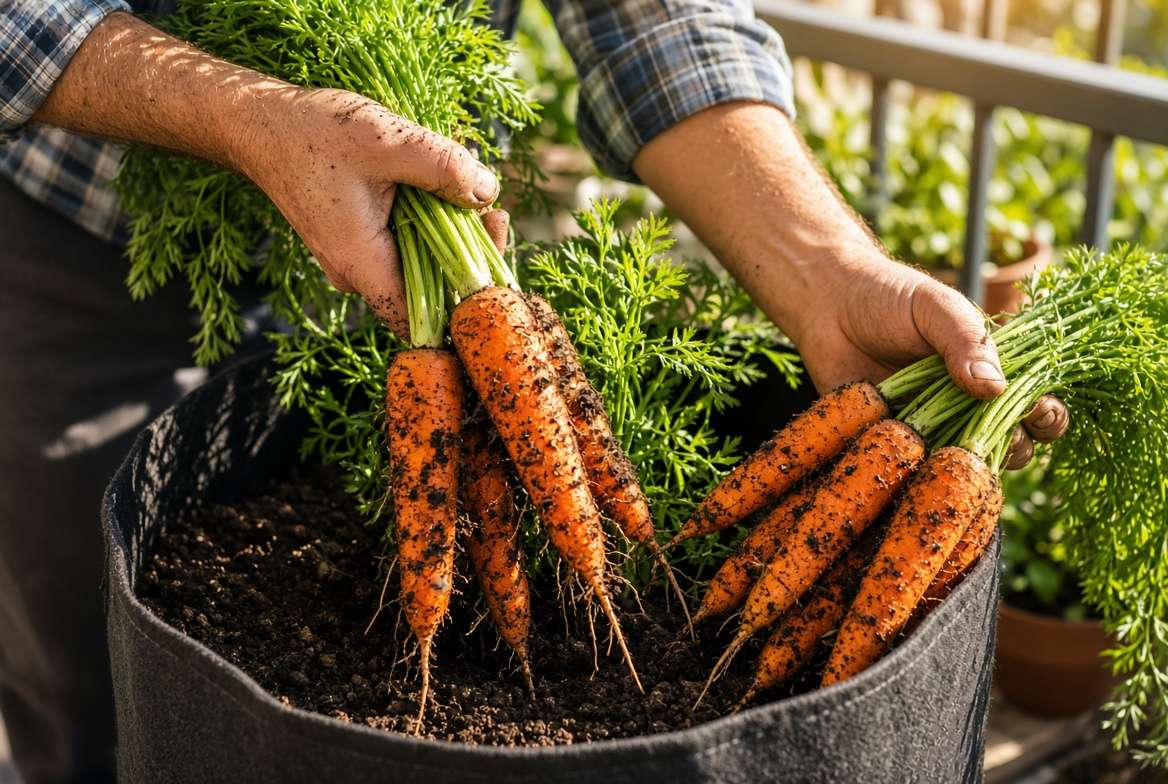
Water the pot a few hours before harvesting to loosen the soil.
-
Use a small hand trowel or a butter knife to gently loosen the dirt around the edges of the carrot.
-
Grab the carrot firmly by the base of the greens, right where they meet the top of the root, and gently twist and pull upward.
Frequently Asked Questions (FAQs) 🙋♀️💬
Can I grow carrots in a 5-gallon bucket on my balcony? Absolutely! A standard 5-gallon bucket is about 14 inches deep, which is perfect for most carrot varieties. Just ensure you drill at least 5-6 large drainage holes in the bottom before adding your soil.
How late in the year can I plant carrots in pots? Carrots love cool weather and can tolerate light frosts. You can plant a late-summer crop for a fall harvest. In milder climates, balcony pots can often sustain carrots well into the winter! Frost actually causes the starches in carrots to convert to sugars, making them incredibly sweet.
Can you regrow carrots from carrot tops? This is a popular internet myth. If you cut the top off a carrot and place it in water or soil, it will sprout beautiful, fern-like green foliage (which is great for pesto!). However, it will not regrow a new orange taproot.
Do carrots need direct sunlight or just warmth? They need light, not heat. In fact, carrots struggle in extreme heat. They require the photons from direct sunlight for photosynthesis to store energy in their taproot. If your balcony gets brutally hot in mid-summer, provide some afternoon shade.
Conclusion: Start Your Balcony Carrot Farm Today! 👩🌾🏙️
You don’t need acres of land or a sprawling raised bed to enjoy the unbeatable taste of homegrown, organic root vegetables. By choosing the right varieties, utilizing fluffy soil, and maintaining consistent moisture, growing carrots in deep pots for balconies is an incredibly rewarding experience.
With a few deep containers and a little bit of patience, your apartment balcony can become a productive, vibrant oasis. So grab some seeds, fill up those pots, and get ready to enjoy the freshest, crunchiest carrots you’ve ever tasted!
Now it’s your turn! What variety of carrot are you planning to grow on your balcony this season? Do you have any creative container gardening setups you want to show off? Let us know in the comments below! And if you enjoyed this guide, be sure to check out our complete tutorial on Growing Tomatoes in Balcony Containers next! 🍅🪴











