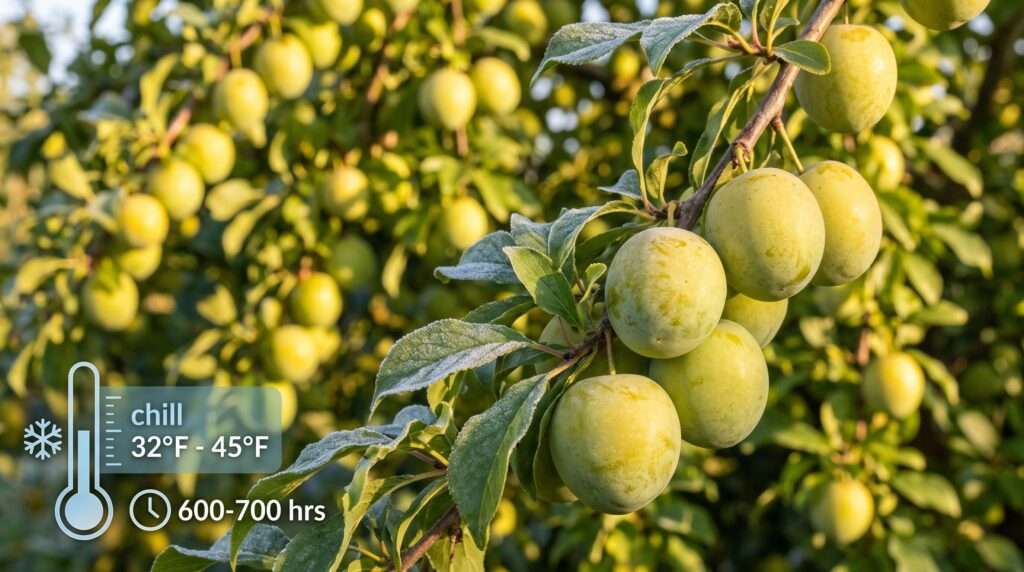
Imagine dedicating three years to nurturing a backyard fruit tree. You water it perfectly, prune it meticulously, and fertilize it on schedule. Spring arrives, but instead of a glorious canopy of white blossoms, your tree produces just a handful of weak flowers—and ultimately, zero fruit. This heartbreak is incredibly common among home orchardists, and it almost always comes down to one overlooked factor: winter dormancy. Before you plant, you must understand one vital metric: the exact chill hours emerald beaut plum tree environments must provide for the plant to wake up and produce a heavy harvest.
The Quick Answer: The Emerald Beaut plum tree requires exactly 600 to 700 chill hours (hours spent between 32°F and 45°F during the winter months) to successfully break dormancy, bloom, and produce fruit.
If you live in a climate that doesn’t hit this target, your tree will struggle to set fruit, no matter how much you baby it. But if you have the right climate, the Emerald Beaut is arguably one of the most rewarding, delicious, and low-maintenance Japanese plums you can grow.
In this comprehensive guide, we will dive deep into the science of winter dormancy, how to accurately calculate your local chill hours, the best pollination partners to double your harvest, and expert care secrets to ensure your Emerald Beaut thrives for decades. 🌱✨
🌳 Meet the Emerald Beaut Plum: A Late-Season Gem
To understand why the Emerald Beaut is worth the effort of tracking winter temperatures, you have to understand what makes this specific cultivar a superstar in the fruit tree world. Introduced by legendary fruit breeder Floyd Zaiger, the Emerald Beaut (Prunus salicina) is a Japanese plum variety that breaks all the rules of what a plum should be.
Why Growers Love the Emerald Beaut 💚
Most plums have a very short harvest window. They ripen rapidly, turn mushy within a few days, and fall off the tree if not picked immediately. The Emerald Beaut is entirely different.
-
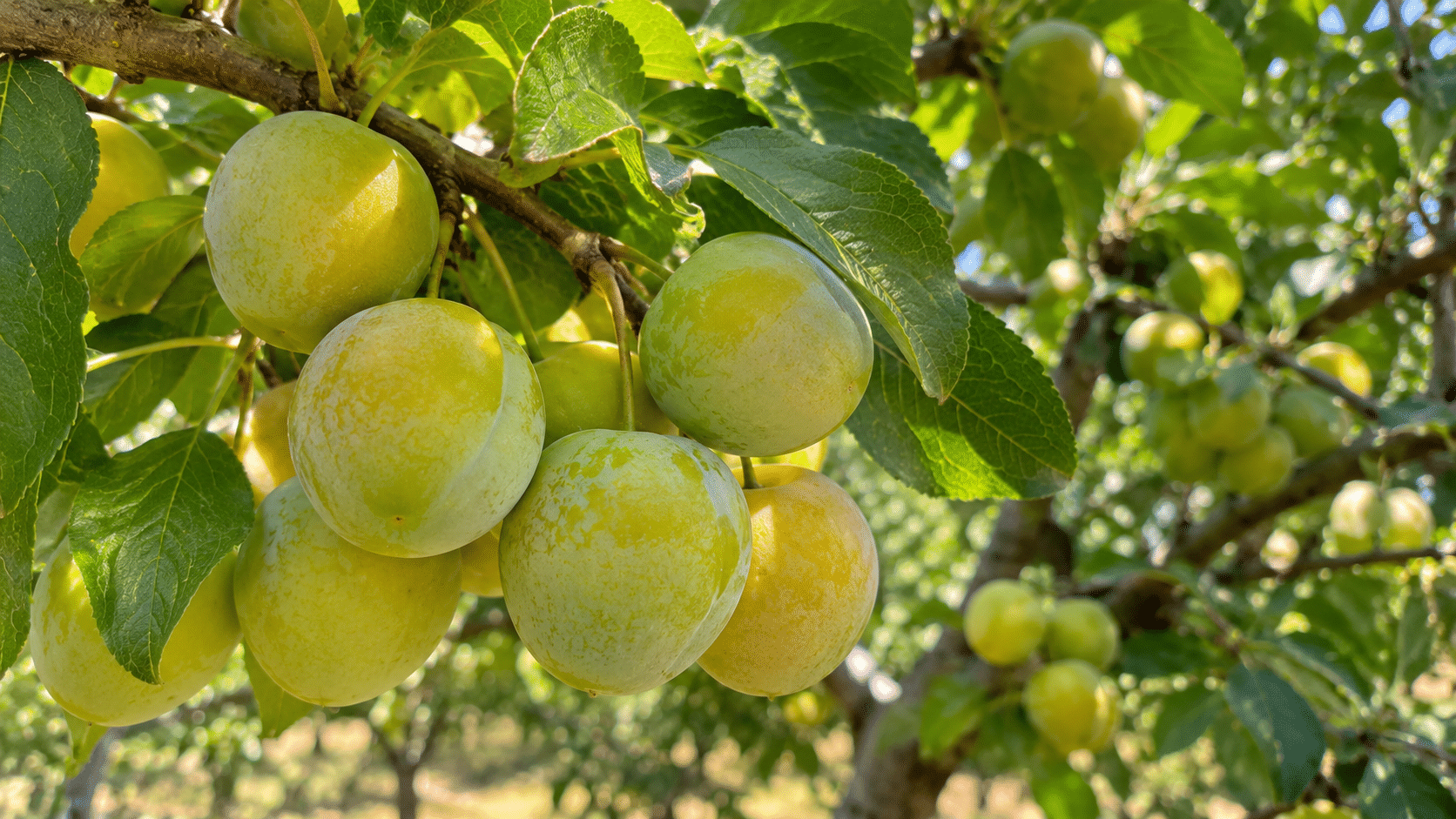
Exceptional Crunch: This plum has a firm, crisp texture that snaps like an apple when you bite into it. It is a freestone variety, meaning the flesh pulls away easily from the pit.
-
Deceptive Color: Unlike traditional dark purple or red plums, the Emerald Beaut features a pale green skin that turns a soft greenish-yellow as it ripens.
-
Incredible Shelf Life on the Tree: This is its true superpower. The fruit ripens on the tree but remains firm and crisp for up to two months. It continues to sweeten as it hangs, reaching astonishing Brix (sugar) levels without ever turning mealy or mushy.
The Exceptional Harvest Timeline 🗓️
While early-season plums like the Methley or Santa Rosa are harvested in June or July, the Emerald Beaut is a late-season gem. In most zones, the fruit begins to ripen in late August and can hold on the branches well into October. For backyard growers, this extends the fresh fruit season perfectly, providing a late-summer bridge between early stone fruits and autumn apples.
❄️ The Magic Number: The Science of Winter Dormancy
So, why does a tree care about how cold it gets? Fruit trees native to temperate climates have evolved a brilliant survival mechanism: they go to sleep.
During the winter, trees enter a state of dormancy to protect their delicate vegetative and floral buds from freezing temperatures. To ensure they don’t wake up too early during a random warm week in January (only to be killed by a February freeze), trees track the cold.
What Exactly Are “Chill Hours”? 🌡️
Chill hours are the metric trees use to measure the passage of winter. Specifically, one chill hour is recorded for every hour the ambient air temperature stays between 32°F and 45°F (0°C to 7°C).
Once the Emerald Beaut accumulates its required 600 to 700 hours within this temperature band, internal growth inhibitors (like abscisic acid) break down, and growth promoters (like gibberellins) take over. The tree is now “unlocked” and ready to bloom as soon as spring temperatures warm up.
The 45-Degree Rule Explained 📉
Calculating chill hours isn’t just a simple matter of counting cold days. The science is surprisingly dynamic:
-
Too Cold Doesn’t Count: Temperatures below 32°F (0°C) do not contribute to chill hour accumulation. The tree is essentially in a deep freeze and metabolic tracking pauses.
-
The Sweet Spot: The most effective temperatures for breaking dormancy are right around 35°F to 45°F.
-
Warm Spikes Erase Chill: According to advanced agricultural tracking methods (like the Utah Model), temperatures above 60°F (15°C) during the winter can actually subtract from a tree’s accumulated chill hours, reversing the dormancy process.
💡 Expert Insight Box: Because the Emerald Beaut requires 600–700 hours, it is classified as a “moderate-chill” tree. It requires a distinct, moderately cold winter. It is not suitable for ultra-low chill regions (like southern Florida) where it might only get 200 hours, nor is it ideal for harsh northern climates where deep sub-zero freezes dominate the winter without offering enough moderate 35°F–45°F days.
🗺️ How to Calculate Your Local Winter Chill Hours
The most common mistake home gardeners make is confusing USDA Plant Hardiness Zones with chill hours. While they are related, they measure entirely different things.
USDA Hardiness Zones vs. Chill Hours 📊
-
USDA Zones measure the extreme lowest temperature a region experiences in winter. This tells you if a tree will freeze to death.
-
Chill Hours measure the cumulative duration of moderate winter cold. This tells you if a tree will wake up and fruit.
For example, two cities can both be in USDA Zone 8 (meaning their lowest winter temperature is between 10°F and 20°F). However, one city might be in the humid, cloudy Pacific Northwest and accumulate 1,200 chill hours, while the other is in sunny Texas and accumulates only 400 chill hours because daytime temperatures frequently spike into the 60s.

Tools to Track Your Local Chill Hours 🔍
To ensure your Emerald Beaut plum will thrive, you need localized data. Here are the best ways to find it:
-
GetChill.net: This free online tool allows you to pull data from a local weather station. Simply find your nearest station on Weather Underground, input the station ID, and GetChill will calculate your precise chill hours using several botanical models.
-
University Agricultural Extensions: If you live in the United States, your local county extension office or state university (like UC Davis in California or Texas A&M) publishes annual winter chill data for local counties.
-
Midwestern Regional Climate Center (MRCC): Their VIP (Vegetation Impact Program) chilling hour maps are incredibly accurate for tracking cold accumulation from October 1st through February.
Step-by-Step Guide for Home Gardeners 🏡
Before purchasing a bare-root Emerald Beaut:
-
Look up your 5-year average chill hours, not just last year’s data. Winters fluctuate, and you want an average that consistently hits above 600.
-
Assess your microclimate. A tree planted against a dark, south-facing brick wall will experience warmer winter temperatures (accumulating fewer chill hours) than a tree planted in an open, north-facing lawn.
-
If your average is firmly between 650 and 850 hours, you have the absolute perfect climate for an Emerald Beaut.
🌎 The Best Climate Zones for the Emerald Beaut Plum
Now that you know how to calculate winter cold, how does that translate to a map? While chill hours are the ultimate deciding factor, USDA Hardiness Zones give us a reliable starting point for where the Emerald Beaut will thrive.
The Sweet Spot: USDA Zones 6–9 🎯
The Emerald Beaut plum is exceptionally well-suited for USDA Zones 6 through 9. These regions typically offer the perfect Goldilocks climate for moderate-chill stone fruits:
-
Winters are cold enough for a sustained period to easily rack up 600 to 700 chill hours.
-
Summers are long, hot, and dry enough to allow the late-season fruit (harvested in late August to September) to fully develop its legendary sugars.
-
Regions like the Central Valley of California, parts of the Pacific Northwest, and moderate southern states (like higher elevations in Texas or the Carolinas) are prime real estate for this tree.

Can You Grow It in Colder or Warmer Zones? 🌡️
-
Too Cold (Zones 4-5): Pushing this tree into colder northern climates is risky. While the tree itself might survive the winter, its moderate chill requirement means it will wake up too early in the spring. If a late spring frost hits after the tree has bloomed, it will kill the fragile flowers, resulting in zero fruit for the year.
-
Too Warm (Zones 10+): In tropical or desert regions (like Miami or Phoenix), the tree will suffer from a condition called “delayed foliation.” Because it never receives its required 600 hours of chill, it stays confused. It will sprout leaves sporadically, bloom weakly over several months rather than in one strong flush, and ultimately fail to set a meaningful crop.
🐝 Pollination Partners: Does the Emerald Beaut Need a Friend?
You’ve checked your climate, and you have the perfect chill hours. Now, do you need to buy just one tree, or two?
Understanding Self-Fruitful vs. Cross-Pollination 🌸
The Emerald Beaut is classified as partially self-fruitful. This means that a single tree, planted all by itself, will produce some fruit using its own pollen. However, for a backyard orchardist looking for a heavy, branch-bending harvest, “partially self-fruitful” is not enough.
To achieve maximum yields and perfectly formed fruit, the Emerald Beaut requires cross-pollination from a different, compatible plum variety that blooms at the exact same time.
Best Pollinator Trees for Emerald Beaut 🌳🤝🌳
Because the Emerald Beaut is a Japanese plum (Prunus salicina), it must be pollinated by another Japanese plum (European plums will not work). The best partners are those that also require moderate chill hours so their bloom times naturally synchronize:
-
Santa Rosa Plum: The gold standard of pollinators. It produces copious amounts of pollen and blooms in the exact same mid-season window.
-
Flavor King Pluot: A plum-apricot hybrid that pairs beautifully with the Emerald Beaut, offering you a completely different flavor profile while effectively pollinating your tree.
-
Burgundy Plum: An excellent, highly productive pollinator with visually striking red foliage and sweet red fruit.
Timing the Bloom ⏱️
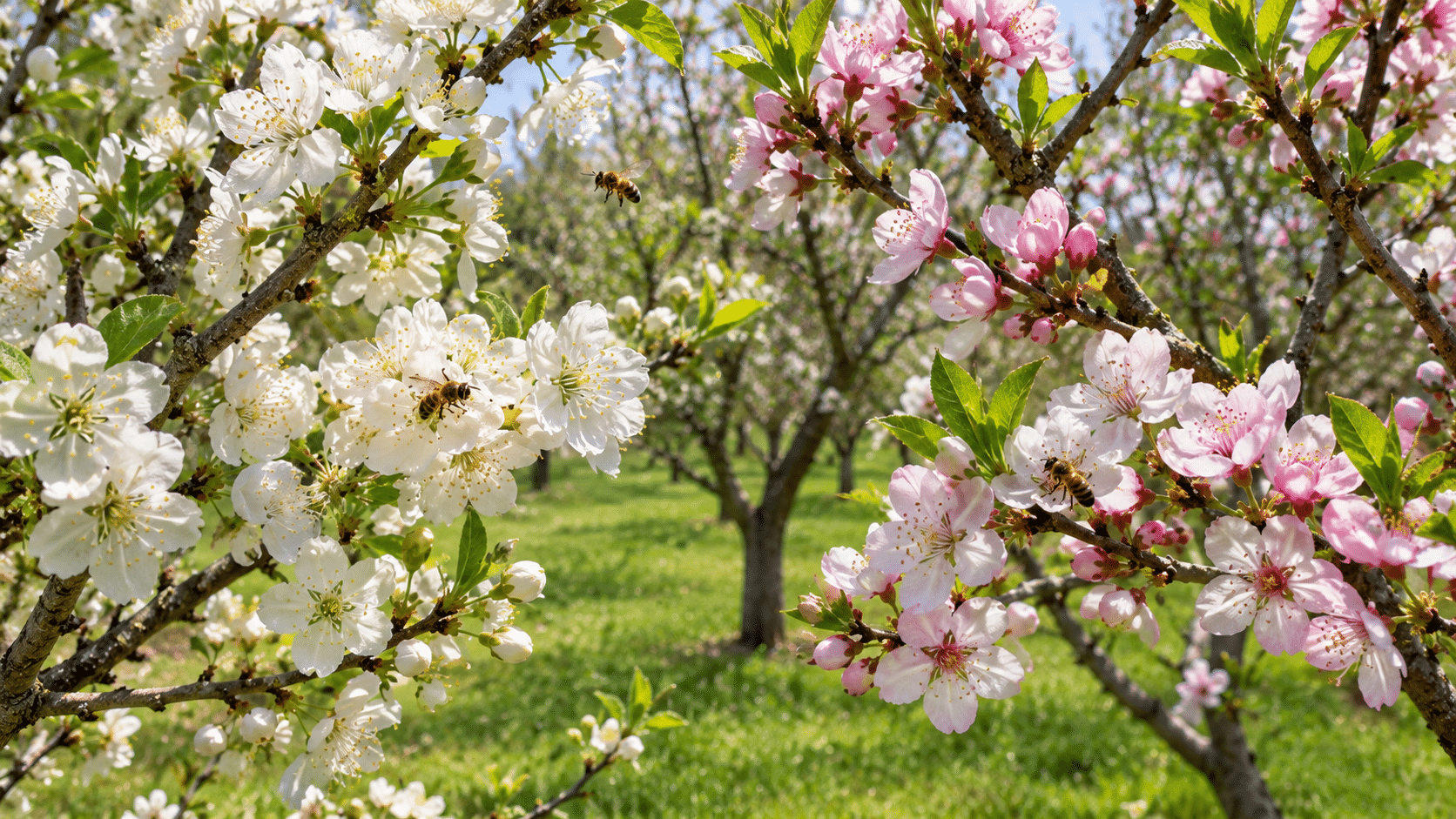
Here is where winter cold plays its final trick: chill hours directly synchronize the blooming periods of your primary tree and its pollinator. If you pair a 600-hour Emerald Beaut with a 250-hour low-chill plum (like a Beauty plum), a mild winter might cause the Beauty to wake up and bloom in February, while the Emerald Beaut sleeps until March. Without overlapping blooms, cross-pollination fails. Always pair trees with similar chill requirements!
✂️ Expert Care Guide: Maximizing Your Plum Harvest
Once your tree is in the ground and paired with a pollinator, proper care will ensure it lives up to its vigorous reputation.
Pruning for Airflow and Sunlight ☀️
Japanese plums are aggressive growers. Left unpruned, they will create a dense, tangled canopy that blocks sunlight and encourages fungal diseases.
-
The Open-Center Method: The Emerald Beaut responds best to an “open-center” or vase-shaped pruning style. During the tree’s winter dormancy, prune out the central leader (the main vertical trunk) and select 3 to 4 strong lateral branches to act as the main scaffolding. This allows sunlight to penetrate the center of the tree, which is critical for ripening those late-summer fruits and developing their high sugar content.
-
Thinning Fruit: Because this tree is such a heavy producer, you must thin the fruit in early summer. Leave about 4 to 6 inches of space between each plum. If you don’t thin, the sheer weight of the fruit can snap the branches!
Soil and Watering Needs During Dormancy 💧
While your tree is racking up its winter chill hours, it does not need much water. The roots are inactive.
-
⚠️ Common Mistake Alert: Many beginners leave their automatic drip irrigation running on their summer schedule throughout the winter. Overwatering a dormant plum tree in cold, heavy soil is a guaranteed recipe for root rot. Only water during the winter if you are experiencing a severe, prolonged dry spell.
Fertilization Schedule 🌿
Do not fertilize your tree during the fall or winter. Applying nitrogen when the tree is trying to enter dormancy will encourage a flush of tender, new growth that will immediately be killed by winter frosts. Instead, apply a balanced, organic fruit tree fertilizer (like a 4-8-4 blend) in early spring, just as the buds begin to swell.
🛑 Troubleshooting: What If You Miss the Chill Hour Target?
Climate change and unseasonably warm winters happen. What happens to your Emerald Beaut if your area only gets 400 chill hours one year?
Signs Your Tree Didn’t Get Enough Chill 🥀
If you miss the target, your tree will exhibit classic symptoms of delayed dormancy break:
-
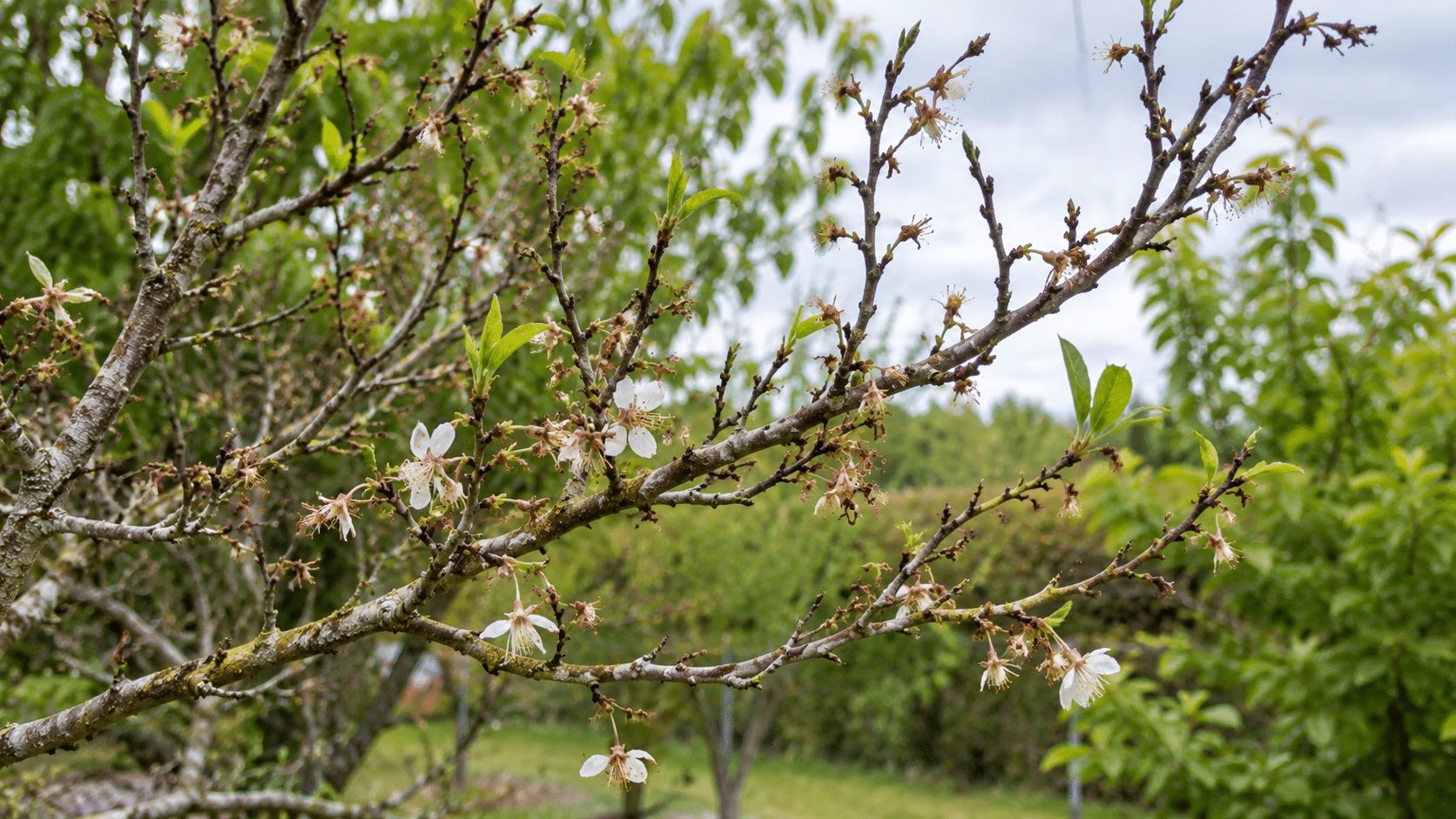
Sporadic Blooming: Instead of a gorgeous week-long display of white flowers, the tree will push out a few blossoms here and there over the course of two months.
-
Delayed Leafing: The tips of the branches may remain bare well into late spring, with only the lower branches pushing out leaves.
-
Dropped Blossoms: The tree may lack the energy to set fruit, causing the flowers to simply shrivel and drop off without forming a plum.
Can You Fake Chill Hours? 🧊
Internet gardening forums are full of myths about “faking” chill hours. Let’s set the record straight:
-
Dumping Ice on the Roots: Myth. Chill hours are calculated by the ambient air temperature hitting the vegetative buds on the branches, not the soil temperature surrounding the roots.
-
Dormant Oil Sprays: Fact (Partially). Commercial orchards sometimes use specialized horticultural oils or chemical dormancy-breaking sprays (like hydrogen cyanamide) to artificially stimulate buds in warm years. However, these are highly toxic, difficult for home growers to time correctly, and can severely burn the tree if misapplied. They can only compensate for a slight deficit (about 50-100 hours), not replace true winter chill.
🍑 Emerald Beaut vs. Other Popular Plum Varieties
Not sure if the Emerald Beaut is the right fit for your backyard orchard? Here is how it stacks up against other popular cultivars:
| Plum Variety | Chill Hour Requirement | Harvest Season | Flavor Profile & Texture |
| Emerald Beaut | 600 – 700 Hours | Late (August – Sept) | Freestone. Exceptionally crisp, crunchy like an apple. Extreme sweetness that increases on the tree. |
| Santa Rosa | 300 – 500 Hours | Early (June – July) | Clingstone. Classic sweet-tart flavor with juicy, soft red flesh. The universal pollinator. |
| Methley | 150 – 250 Hours | Very Early (May – June) | Clingstone. Extremely juicy, soft, and sweet. Ideal for low-chill, warm southern climates. |
| Burgundy | 250 – 350 Hours | Mid (July – August) | Freestone. Mild, sweet flavor with very little tartness. Striking dark red skin and flesh. |
❓ Frequently Asked Questions (FAQs)
Q: Can the Emerald Beaut plum tree grow in Southern California?
A: It depends heavily on your microclimate. In the inland valleys of Southern California, yes, you will likely hit the 600-hour mark. However, in coastal regions like San Diego or Los Angeles, winters are typically too mild (often under 300 hours). For coastal SoCal, opt for a low-chill variety like the Santa Rosa or Beauty plum instead.
Q: How long does it take for an Emerald Beaut to produce fruit?
A: If you plant a healthy, 2-to-3-year-old bare-root tree from a reputable nursery, you can expect your first small harvest in about 3 to 4 years. By year 5 or 6, it will be in full production.
Q: Are Emerald Beaut plums green when ripe?
A: Yes! This confuses many beginners who wait for the plum to turn purple or red. The skin starts pale green and shifts to a yellowish-green when fully ripe. If it feels slightly giving to the touch (though still much firmer than a regular plum) and easily pulls away from the branch, it is ready to eat.
Q: Does one freezing night count as multiple chill hours?
A: No. In fact, extreme freezing nights (below 32°F / 0°C) do not count as chill hours at all. The tree essentially hits “pause” on tracking cold during a hard freeze. Chill hours only accumulate when the temperature hovers between 32°F and 45°F.
🎯 Conclusion: Setting Up for a Sweet Success
Growing backyard fruit is one of the most rewarding gardening experiences, but it requires aligning nature’s rules with your own landscape. By understanding the exact chill hours emerald beaut plum tree biology demands, you are actively preventing years of frustration and setting yourself up for incredible success.
Before you order your bare-root tree this winter, take ten minutes to check your local county’s historical chill hour data. If you consistently hit that magic 600 to 700-hour mark, the Emerald Beaut will reward you with one of the most unique, crisp, and intensely sweet harvests of the late summer season.
Happy planting! 🌱