
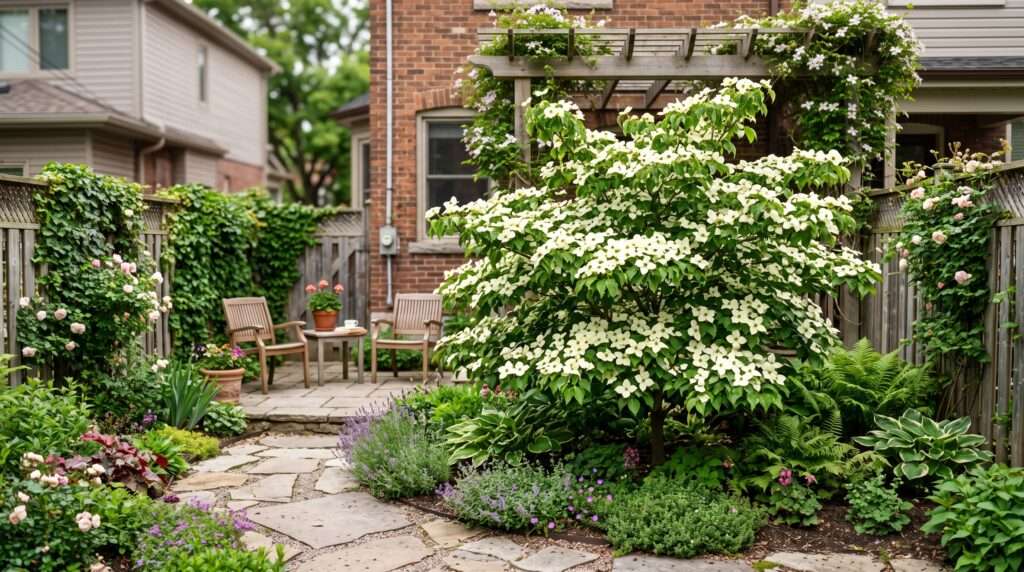
There is a distinct heartbreak in falling in love with the sweeping, architectural beauty of a standard flowering dogwood, only to realize its 25-foot canopy will completely overwhelm your modest patio or encroach on overhead power lines. For urban and suburban gardeners grappling with limited outdoor space, achieving a magazine-worthy landscape can feel like a frustrating puzzle. Enter the dwarf dogwood tree—the ultimate space-saving solution that delivers the exact same signature floral displays, vibrant fall foliage, and iconic horizontal branching, but in a fraction of the footprint.
If you are trying to design a high-impact, low-maintenance yard, you do not need acres of rolling lawns. By strategically selecting compact dogwood cultivars, you can anchor your garden’s aesthetic without buckling foundation walkways or shading out your entire lawn.
🧑🌾 The Horticulturist’s Perspective: Managing Expectations
When we evaluate compact trees over a 10-year timeline, genetics matter. A standard Cornus florida grafted onto typical rootstock will aggressively seek its natural 20–30 foot height. True dwarf and compact genetics, however, are bred to top out gracefully, maintaining their tight internodes and dense branching structure without requiring constant, stressful pruning. Understanding your soil’s diagnostic health and selecting the right genetic cultivar is the secret to a thriving small-space landscape.
Quick Snapshot: Standard vs. Dwarf Dogwood 📏
| Feature | Standard Dogwood (Cornus florida / kousa) | Dwarf / Compact Dogwood Cultivars |
| Mature Height | 20 – 30+ feet | 5 – 12 feet (varies by cultivar) |
| Mature Spread | 25 – 30 feet | 4 – 10 feet |
| Root Radius | Expansive (competes with turf) | Contained, safe for tight borders |
| Ideal Yard Size | 1/4 Acre to Large Estates | Courtyards, Patios, Urban Lots |
2. Botanical Clarification: Groundcovers vs. True Compact Trees 🔍
To establish a successful landscape and avoid costly buying mistakes at the nursery, we must first clear up a common naming confusion in the horticultural world. Not everything labeled “dwarf” is actually a tree.
The “Bunchberry” Mix-Up (Cornus canadensis) 🌿
If you search for the smallest dogwoods, you will inevitably encounter Cornus canadensis, commonly known as Bunchberry. While technically in the dogwood family and possessing identical-looking white flowers, this is a native subshrub or creeping groundcover. It reaches only 4 to 8 inches in height. Plant catalogs sometimes ambiguously list it as a “miniature dogwood.” While excellent as an understory carpet in acidic, woodland soils, it will not give you the vertical, tree-like focal point you want for a small yard.
True Dwarf & Compact Tree Cultivars 🧬
When we talk about a dwarf dogwood tree for landscaping, we are referring to specific genetic mutations (often natural “witches’ brooms”) or carefully bred selections of Cornus kousa (Asian Dogwood) and Cornus florida (American Dogwood). In the nursery trade, “dwarf” usually denotes a tree that will reach 6 to 12 feet at absolute maturity, rather than the standard 20 to 30 feet. These trees give you a distinct trunk, structural canopy, and under-planting clearance, scaled down perfectly for tight corners.
3. Top Dwarf & Compact Dogwood Varieties for Small Landscapes 🌳🏷️
Selecting the right cultivar dictates the entire success of your space. Here is a comprehensive breakdown of the highest-performing compact selections, highly optimized for visual impact—perfect for capturing those highly photogenic, shareable moments in the garden. 📸

Cornus kousa ‘Little Poncho’ – The Patio Showstopper 🌸
-
Profile: A magnificent, densely branched tree reaching a mature height of just 8 to 10 feet. It produces pristine white, pointed star-like bracts in late spring, heavily covering the foliage. By late summer, it develops highly ornamental, edible raspberry-like syncarps (fruits).
-
Best for: Courtyards, large decorative resin containers, and tight property borders. Because Cornus kousa varieties bloom a few weeks later than natives, the leaves act as a beautiful deep green backdrop to the white flowers.
Cornus florida ‘Pygmaea’ (Pygmy Dogwood) – The Native Classic in Miniature 🍂
-
Profile: This ultra-compact, rounded tree slowly matures to around 5 to 7 feet tall and wide. It features the classic, rounded white spring bracts that American dogwoods are famous for, followed by a deeply saturated, rich scarlet autumn foliage display.
-
Best for: Front-entry focal points, foundational corner plantings, and dappled woodland edges. It provides massive curb appeal without blocking first-story windows.
Cornus mas ‘Nana’ – Early Spring Pollinator Haven 🐝
-
Profile: A dwarf form of the Cornelian Cherry Dogwood, reaching about 5 to 8 feet. Unlike its cousins, this variety explodes with clusters of golden-yellow flowers in late winter or very early spring, well before the foliage emerges.
-
Best for: Cold-climate small yards (hardy to Zone 4) seeking a bright transition out of winter. The early blooms are a vital resource for early-emerging pollinators.
Cornus sericea ‘Kelseyi’ – The Compact Winter Accent ❄️
-
Profile: While technically a multi-stemmed dwarf shrub (maturing at 2 to 3 feet tall), ‘Kelseyi’ deserves a spot in small yards for its brilliant red winter stems.
-
Best for: Rain gardens, low foundation hedges, and providing striking winter landscape interest against a snowy backdrop. It boasts a fibrous root system that excels at erosion control.
4. Four Seasons of High-Impact Landscape Value 🍂❄️
In a small yard, you do not have the luxury of planting “one-hit wonders”—plants that look good for two weeks and remain plain for the rest of the year. Every square inch must work overtime. A dwarf dogwood tree is the ultimate workhorse, replacing multiple single-season perennials by offering four distinct seasons of visual interest.
-
Spring 🌸: The layered canopy architecture comes alive with dramatic bract displays (often mistakenly called petals). These blooms last for weeks, making your compact spaces feel intentionally, professionally designed.
-
Summer 🍃: As the flowers fade, deep green, disease-resistant foliage takes over. Because these trees are compact, they provide a cooling, dappled micro-shade perfect for nurturing delicate, low-growing companion plants underneath.
-
Autumn 🍁: Dogwoods are unrivaled in fall. Expect an intense transition into crimson, bronze, and purple foliage. This is coupled with the emergence of bright red, persistent ornamental berries that attract local songbirds.
-
Winter 🌨️: Even bare, the tree shines. The structural, horizontal branching holds fresh snowfall gracefully, while prominent, biscuit-shaped floral buds wait tightly on the tips of the branches, promising spring’s return.

5. Site Selection & Microclimate Planning 🧭☀️
The secret to maximizing the health and lifespan of your ornamental trees lies in understanding microclimates. Small yards—particularly in urban or densely populated suburban environments—often possess unique environmental challenges like reflective heat from vinyl fences, restricted air flow, and compacted fill dirt. Proper site selection prevents stress before the tree even goes into the ground.
Sunlight Balancing: Morning Glow vs. Afternoon Scorch 🌤️
While standard dogwoods are historically understory trees accustomed to dappled woodland light, modern compact cultivars are surprisingly adaptable. However, the golden rule of site selection remains: prioritize morning sun and afternoon shade. East-facing exposures are ideal. The gentle morning light dries dew from the foliage (preventing fungal issues), while protection from the harsh 3:00 PM sun prevents leaf scorch. If your small yard only offers full sun, ensure the soil is heavily mulched and consistently irrigated to cool the root zone.
Safe Setback Distances & Underground Space 🏡
One of the most significant advantages of a dwarf dogwood tree is its non-aggressive, fibrous root system. Unlike maples or willows that will relentlessly seek out plumbing and lift concrete, compact dogwoods have shallow, well-behaved roots.
-
Walkways & Patios: You can safely plant a dwarf cultivar as close as 4 to 5 feet from a concrete patio or foundation walkway.
-
Underground Utilities: Because their roots rarely grow deep enough to interfere with modern municipal lines or septic fields, they are incredibly safe for front-yard utility easements.
Pairing Companions in Tight Borders 🌿
In a small yard, layering is critical for a lush, Pinterest-worthy landscape design. Because dwarf dogwoods provide cooling micro-shade without aggressively competing for surface nutrients, they make perfect canopy anchors for shade-loving companions. Plant a visually striking understory featuring Hostas, the cascading yellow blades of Japanese Forest Grass (Hakonechloa), native Columbine, and early spring bulbs like snowdrops and crocuses.
6. Expert Planting & Establishment Protocol 🪴🧑🌾
Planting a tree correctly on day one eliminates 90% of the problems you might face in year ten. For compact ornamental trees, precision in the planting protocol is essential.
Soil Conditioning for Sensitive Fibrous Roots 🪱
Dogwoods absolutely despise “wet feet” (waterlogged soil) and heavy clay. They thrive in well-draining, slightly acidic soil with a pH between 5.5 and 6.5. Before planting, test your soil’s drainage by digging a 12-inch hole and filling it with water; if it takes longer than a few hours to drain, you need to amend the area. Mix your native soil with high-quality organic leaf compost to improve aeration, replicating the rich, spongy floor of a natural forest.
The Root Flare Rule (Avoiding the Number-One Planting Mistake) ⚠️
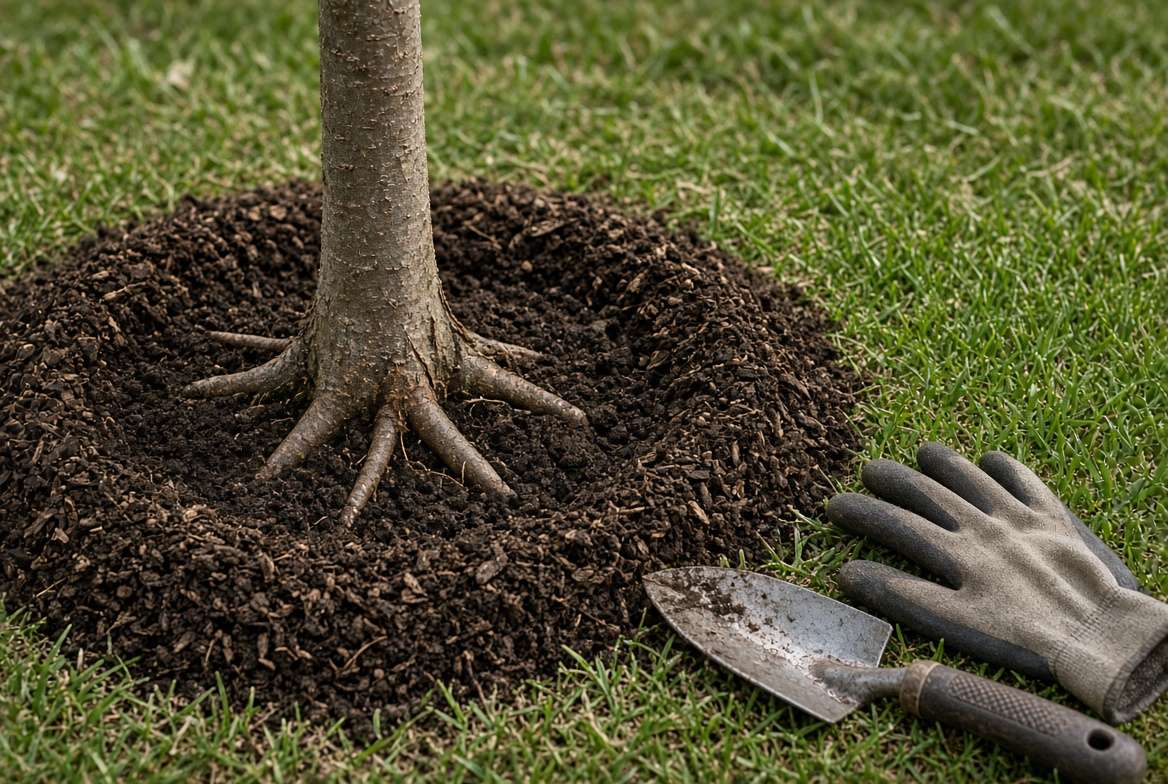
The most common reason newly planted trees fail is being buried too deeply. Always locate the tree’s root flare—the widened base of the trunk where it transitions into the root system.
-
Dig your hole three times as wide as the nursery root ball, but exactly the same depth.
-
Place the tree in the hole so that the root flare sits 1 to 2 inches above the surrounding soil grade.
-
Backfill gently, avoiding burying the trunk, which invites rot and suffocates the plant.
The Critical Year-One Hydration Strategy 💧
During the first growing season, your dwarf tree is working overtime to establish its root system. Skip the frequent, shallow splashings with a garden hose; this encourages weak, surface-level roots. Instead, utilize the deep-soak method. Apply 10 to 15 gallons of water slowly at the base of the tree once a week (twice a week during extreme heat waves). Setting up a simple drip irrigation line or using a slow-release watering bag is a highly efficient way to manage this in small plots.
7. Long-Term Maintenance: Keeping Dwarf Trees Thriving ✂️🛡️
A well-chosen dwarf dogwood is remarkably low-maintenance, but “low maintenance” does not mean “zero maintenance.” Implementing proactive care routines ensures pristine foliage and heavy blooming.
Pruning for Health, Not Size Reduction ✂️
Because you have intentionally planted a compact cultivar, you will never need to subject the tree to aggressive “topping” or severe size-reduction pruning—practices that ruin natural dogwood architecture. Restrict your pruning exclusively to the “Three Ds”: Dead, Damaged, and Diseased wood. Perform any structural thinning in late winter while the tree is fully dormant to prevent sap bleeding and insect attraction.
Mulching Without “Mulch Volcanoes” 🪵
Mulch is essential for retaining root moisture and regulating soil temperature, but it is frequently misapplied. Create a proper 3-inch “doughnut” mulch ring extending out to the tree’s drip line. Never let the mulch touch the bark of the trunk. The notorious “mulch volcano” traps moisture against the bark, leading to crown rot and providing a hiding place for rodents that chew on the wood during winter.
Preventative Health: Powdery Mildew, Anthracnose & Dogwood Borer 🛡️
Proactive environmental management is the best pest and disease defense.
-
Powdery Mildew & Anthracnose: These fungal issues thrive in stagnant, humid air. Combat them by ensuring good air circulation around the canopy and strictly watering at the base of the tree in the morning, keeping the foliage dry overnight. Selecting disease-resistant Cornus kousa hybrids is also a major advantage.
-
Dogwood Borer: These insects exploit wounds in the bark. Protect the trunk from accidental lawnmower or string-trimmer strikes by maintaining a wide, protective mulch ring.
8. Can You Grow Dwarf Dogwood Trees in Containers? 🪴🏡
Yes! For renters, balcony gardeners, or those with entirely hardscaped courtyards, growing a dwarf dogwood tree in a container is highly achievable and creates an instant focal point.
-
Selecting the Right Vessel: Choose a large container—at least 24 inches in diameter to start. Insulated resin or thick glazed ceramic pots are best, as they protect the sensitive root systems from extreme temperature fluctuations. Ample drainage holes are non-negotiable.
-
The Potting Mix: Do not use garden dirt. Create a custom, lightweight blend of premium potting soil, pine bark fines, and perlite to ensure rapid drainage while maintaining essential moisture.
-
Overwintering (Zones 5–7): Roots in a container lack the geothermal insulation of the earth. In colder hardiness zones, you must protect containerized dogwoods during winter. Move the pot to an unheated garage, wrap the container in burlap and bubble wrap, or group pots tightly together against a sheltered, south-facing brick wall.

9. Frequently Asked Questions (FAQ) 💬
How fast does a dwarf dogwood tree grow? Compact dogwoods are generally slow-to-moderate growers. You can expect them to add roughly 6 to 12 inches of new growth per year depending on soil health and sunlight, slowly expanding into their mature, tight form without rocketing out of control.
Do dwarf dogwood trees produce edible fruit? It depends entirely on the species. Cornus kousa cultivars produce red, round, raspberry-like fruits (syncarps) in late summer that are completely edible and often used in jams, though they have a mealy texture raw. Native Cornus florida berries are beautiful but are mildly toxic to humans and pets (though highly prized by songbirds).
Are dwarf dogwood roots safe near foundations? Yes. Because they utilize a fibrous, shallow root system rather than an aggressive taproot, they will not damage structural foundations, concrete pathways, or underground plumbing.
Can a dwarf dogwood survive full shade? While dogwoods can technically survive in heavy shade, it comes with a severe trade-off: flower production will plummet, and the tree’s growth habit will become leggy and sparse as it stretches for sunlight. For dense, compact growth and heavy spring blooms, partial sun (morning light) is required.
10. Small-Yard Landscaping Action Plan 📋🌱
Ready to transform your compact outdoor space? Follow this quick checklist to get started:
-
Assess Your Light: Identify a planting spot in your yard that receives 4 to 6 hours of morning sun and afternoon shade.
-
Select Your Cultivar: Choose a verified compact tree variety like ‘Little Poncho’ or ‘Pygmaea’ rather than a standard seedling.
-
Prep the Soil: Dig a wide, shallow hole and amend heavy clay with organic compost to guarantee proper drainage.
-
Plant High: Ensure the root flare is visible above the soil line and apply a proper 3-inch mulch ring (no volcanoes!).
-
Commit to Deep Watering: Set up a slow-release watering bag to provide 10–15 gallons of water weekly throughout the first growing season.
With thoughtful selection and proper soil care, a dwarf dogwood tree will effortlessly anchor your landscape, proving that limited space is no barrier to world-class garden design.
Are there any specific companion plants or visual layouts you’re hoping to explore next for your gardening content?











