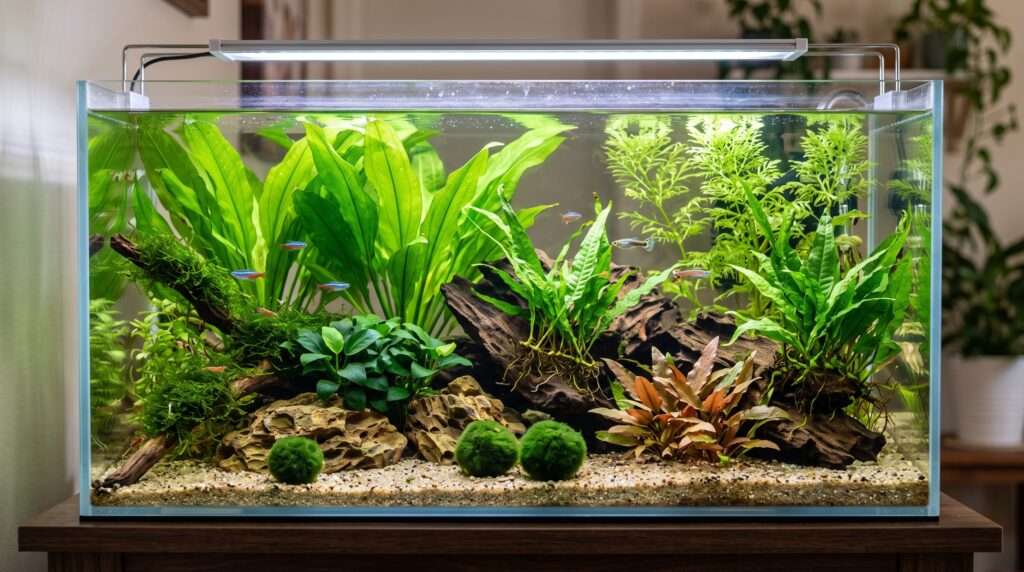
Let’s face it: there is nothing quite as heartbreaking as spending your hard-earned money on beautiful greenery at the local fish store, only to watch it turn brown, melt into a slimy mess, and clog your filter a week later. It is a frustrating cycle that drives many newcomers away from the hobby entirely. If you want to end this cycle of frustration and find the absolute best live aquarium plants for beginners, you have come to the exact right place.
For years, a pervasive myth in the aquascaping community has suggested that to have a lush, vibrant underwater garden, you need an advanced degree in water chemistry, expensive carbon dioxide (CO2) injection systems, and blindingly bright lights. After years of aquascaping, consulting on tank setups, and rescuing dying aquariums, I can confidently tell you that this is simply not true. Success doesn’t come from buying the most expensive equipment—it comes from choosing the right species.
High-tech planted tanks require intense lighting and strict fertilizer dosing schedules that can quickly overwhelm anyone just starting out. But what if I told you that you could cultivate a stunning, natural ecosystem using nothing more than your standard tap water, basic gravel, and the standard LED light that came with your aquarium kit?
In this comprehensive guide, we are going to dive deep into a carefully curated list of 7 low-light, low-maintenance aquatic plants that are practically indestructible. Whether you are setting up your very first 10-gallon tank for a Betta fish, or you are looking to add some natural beauty to an established community aquarium, these plants will give you the “green thumb” guarantee. ✨
Why Choose Low-Tech, Beginner-Friendly Aquarium Plants? 🤔
Before we dive into our list of bulletproof plants, it is crucial to understand why the low-tech approach is the ultimate pathway to success for novice aquarists.
The Myth of the “High-Tech” Tank 💡
Browse any aquascaping forum or Instagram feed, and you will see breathtaking, competition-level tanks that look like manicured underwater forests. These are known as “high-tech” tanks. They utilize pressurized CO2 canisters to force plants to grow at hyper-speed, paired with intense lighting fixtures and complex daily nutrient dosing.
While beautiful, high-tech tanks are a delicate balancing act. If your CO2 spikes, your fish can suffocate. If your lights are too bright and you miss a fertilizer dose, your tank will be overrun with thick, green algae in a matter of days.
Low-tech tanks, on the other hand, rely on the natural balance of nature. By choosing plants that naturally grow in shaded streams or dark river basins in the wild, you eliminate the need for artificial CO2 and blinding lights. These plants grow slower, which means they are far more forgiving of mistakes, require less pruning, and are significantly cheaper to maintain. You get all the aesthetic beauty of a planted tank with a fraction of the stress. 🧘♀️
Incredible Benefits for Your Aquarium 🐠
Adding easy live plants to your tank isn’t just about making it look pretty—it fundamentally upgrades the health and stability of your entire ecosystem. Here is what these aquatic heroes do behind the scenes:
-
Natural Filtration & The Nitrogen Cycle: Fish produce waste, which breaks down into toxic ammonia and nitrates. Live plants act as biological sponges, happily absorbing these harmful toxins to use as food, thereby keeping your water parameters safe and clean for your fish.
-
Superior Oxygenation: Through the magic of photosynthesis, live plants consume the carbon dioxide exhaled by your fish and release fresh, dissolved oxygen directly into the water, allowing your aquatic pets to breathe easier.
-
Stress Reduction and Enrichment: Artificial plastic plants can tear the delicate fins of fish like Bettas and Guppies. Live plants provide soft, natural resting places. They break up the line of sight in the tank, giving shy fish and invertebrates (like cherry shrimp) safe hiding spots, which drastically reduces stress, disease, and territorial aggression. 🦐
The 7 Unkillable Live Aquarium Plants for Beginners 🌱
Get ready to transform your glass box of water into a thriving slice of nature. Here are the top seven hardiest, most forgiving, and undeniably beautiful plants for your low-tech aquarium.
1. Java Fern (Microsorum pteropus) – The Bulletproof Epiphyte 🌿
If there were a hall of fame for beginner aquarium plants, the Java Fern would be its most celebrated member. Originating from Southeast Asia, this plant is legendary for its ability to survive—and even thrive—in conditions that would quickly kill more delicate species.
Java Fern features tall, leathery, emerald-green leaves. Because these leaves are so tough and thick, it is one of the few plants that notorious plant-eating fish (like Goldfish, Cichlids, and Silver Dollars) will generally leave alone. It simply doesn’t taste good to them!
-
Placement: Midground to Background
-
Lighting Needs: Low to Moderate
-
Growth Rate: Slow
-
Ideal Water Temp: 68°F – 82°F (20°C – 28°C)
Expert E-E-A-T Tip: The Java Fern is an epiphyte. This means it draws all its nutrients directly from the water column rather than the soil. Do not bury this plant in your gravel! If you bury its horizontal green stem (called the rhizome), the plant will suffocate and rot. Instead, use a dab of cyanoacrylate superglue (aquarium safe!) or some dark cotton thread to attach the rhizome directly to a piece of driftwood or a rock. It will eventually wrap its roots around the surface like a beautiful, natural jungle vine. 🪵

2. Anubias Nana (Anubias barteri var. nana) – Slow & Steady Beauty 🐢
Anubias Nana is the undisputed crown jewel of low-tech aquascaping. Native to the shaded rivers of West Africa, this plant features gorgeous, broad, dark-green leaves that look almost artificial because they are so pristine and thick.
Like the Java Fern, Anubias is an epiphyte and must have its rhizome exposed to the water. It is incredibly hardy and can tolerate a massive range of water parameters, from soft, acidic water to hard, alkaline water.
-
Placement: Foreground to Midground
-
Lighting Needs: Very Low to Low
-
Growth Rate: Very Slow (roughly one new leaf per month)
-
Ideal Water Temp: 72°F – 82°F (22°C – 28°C)
Care Tip: Because Anubias Nana grows so slowly, it can be susceptible to getting covered in green spot algae if left under direct, bright light for too long. The secret to keeping Anubias looking flawless is to plant it in the shaded areas of your tank. Tuck it under a larger piece of driftwood, or plant it beneath the large, overarching leaves of a taller plant. It loves the shade! ⛱️
3. Amazon Sword (Echinodorus amazonicus) – The Background Giant 🗡️
If you have a large, empty space in the back of your aquarium, or if you desperately want to hide unsightly equipment like your heater, filter intake tubes, or airline tubing, the Amazon Sword is your best friend.
As the name suggests, this plant hails from the Amazon River basin and features stunning, sword-shaped, light-green leaves. Unlike our first two plants, the Amazon Sword is a traditional rooted plant that grows massive, deep root systems. Under the right conditions, this plant can grow huge, eventually reaching the surface of the water and creating a gorgeous canopy.
-
Placement: Background (Centerpiece)
-
Lighting Needs: Low to Moderate
-
Growth Rate: Moderate to Fast
-
Ideal Water Temp: 72°F – 82°F (22°C – 28°C)
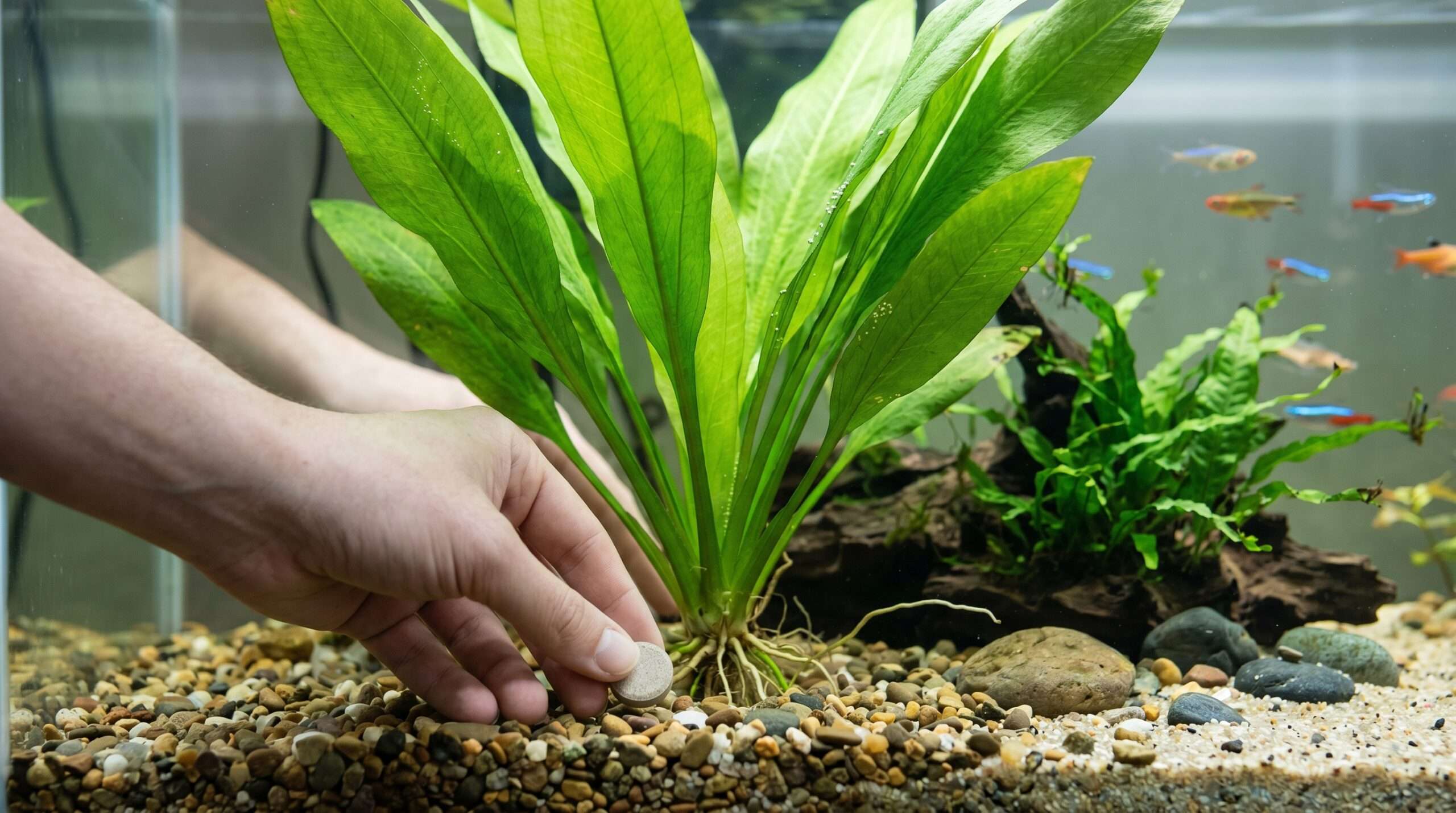
Care Tip: The Amazon Sword is what aquarists call a “heavy root feeder.” While it will survive in basic aquarium gravel, it will not grow to its full, magnificent potential without a little help. To make your Amazon Sword truly explode with growth, simply push a root tab fertilizer pill deep into the gravel right at the base of the plant once every couple of months. It will absorb those nutrients like a sponge! 🧽
4. Cryptocoryne Wendtii (The “Crypt”) – Colorful Resiliency 🍂
If you are tired of looking at a sea of endless green and want to add some warm, natural contrast to your tank, Cryptocoryne wendtii is the perfect choice. Commonly referred to simply as “Crypts,” these resilient plants come in a variety of shades, ranging from deep bronze and brown to rich, vibrant reds, depending on the specific variant you purchase.
Native to Sri Lanka, Crypts are fantastic midground plants with ruffled, wavy leaves. They are highly adaptable to hard or soft water and are incredibly undemanding once established.
-
Placement: Midground
-
Lighting Needs: Low to Moderate
-
Growth Rate: Slow to Moderate
-
Ideal Water Temp: 72°F – 82°F (22°C – 28°C)
Expert E-E-A-T Tip: Before you buy this plant, you must understand a phenomenon known as “Crypt Melt.” When Cryptocoryne is moved from the pet store to a new tank with different water parameters, it often panics and sheds its leaves. They turn mushy and completely dissolve. Do not throw the plant away! This is a completely natural acclimation response. Simply trim away the melting leaves, leave the roots firmly planted in your substrate, and within a few weeks, it will sprout brand new leaves that are perfectly adapted to your specific tank conditions. Patience pays off! 🕰️
5. Java Moss (Taxiphyllum barbieri) – The Ultimate Fry Hideout 🦐
No low-tech planted tank list is complete without Java Moss. This stringy, fuzzy, dark-green moss is quite literally one of the hardest plants to kill in the aquarium hobby. It can survive in near-total darkness, freezing temperatures, and wildly fluctuating water parameters.
Java Moss is a game-changer if you plan on keeping Neocaridina shrimp (like Cherry Shrimp) or livebearing fish (like Guppies, Platies, or Mollies).
-
Placement: Foreground or attached to hardscape
-
Lighting Needs: Very Low to High
-
Growth Rate: Moderate to Fast
-
Ideal Water Temp: 59°F – 86°F (15°C – 30°C)
Use Case: The dense, tangled structure of Java Moss acts as a microscopic buffet, trapping tiny particles of food and growing infusoria (microscopic organisms) that baby fish and baby shrimp graze on all day. It also creates a dense, impenetrable fortress where baby fish can hide from hungry adults. You don’t even need to plant it; simply let it float, or tie it to a piece of driftwood and watch it spread. 🏰
6. Marimo Moss Balls (Aegagropila linnaei) – The Quirky Sphere 🟢
If you are looking for something truly unique, incredibly cute, and almost maintenance-free, look no further than the Marimo Moss Ball. Fun fact: these velvety green spheres are not actually moss at all; they are a rare form of spherical green algae found in only a few lakes in Japan and Northern Europe!
They require zero planting, zero fertilizers, and absolutely no complicated care routines. You just drop them in the water and let them do their thing.
-
Placement: Foreground (Resting on the substrate)
-
Lighting Needs: Very Low to Low
-
Growth Rate: Extremely Slow (they grow about 5mm per year!)
-
Ideal Water Temp: 60°F – 77°F (15°C – 25°C)
Care Tip: In the wild, Marimo Moss Balls are rolled along the lake floor by gentle wave currents, which helps them maintain their perfect spherical shape and ensures all sides get sunlight. To replicate this in your home aquarium, just gently roll or flip your moss balls over with your hand every time you do your weekly water change. This prevents them from developing flat, brown, dead spots on the bottom. 🎱
7. Water Wisteria (Hygrophila difformis) – The Nutrient Sponge 🧽
Water Wisteria is a fantastic stem plant that offers something unique to beginners: rapid growth. While most low-tech plants grow at a snail’s pace, Water Wisteria shoots up quickly, featuring beautiful, bright green, deeply lobed leaves that look like underwater ferns.
Because it grows so quickly, it is arguably the best plant on this list for maintaining pristine water quality.
-
Placement: Background
-
Lighting Needs: Low to Moderate
-
Growth Rate: Fast
-
Ideal Water Temp: 74°F – 82°F (23°C – 28°C)
Benefit: Fast-growing plants are like vacuum cleaners for excess nutrients. If you tend to overfeed your fish (a common beginner mistake!), those extra nutrients usually lead to massive algae blooms. Water Wisteria will aggressively outcompete the algae for those nutrients, absorbing the excess nitrates and keeping your glass crystal clear. When it gets too tall, simply snip the top off with scissors, plant the cutting directly into the gravel, and you will instantly have a brand-new plant! ✂️
How to Plant and Care for Low-Tech Plants Like a Pro 🛠️
Having the right plants is only half the battle. To ensure your new underwater garden thrives, you need to set up a beginner-friendly foundation. Don’t worry—it is much simpler than you might think.
Substrate 101: Sand, Gravel, or Aqua Soil? 🪨
One of the most confusing aspects of aquascaping is choosing the dirt. Advanced aquarists use expensive “active aqua soils” that lower pH and come loaded with nutrients. As a beginner keeping the 7 plants listed above, you do not need aqua soil.
Standard aquarium gravel or play sand works perfectly. Why? Because plants like Java Fern, Anubias, and Java Moss don’t use the substrate anyway. For rooted plants like the Amazon Sword and Crypts, standard gravel is perfectly fine as long as you provide supplemental nutrients (which we will cover in a moment). Save your money and buy a basic, natural-colored gravel or sand that you find aesthetically pleasing.
Lighting Guidelines for Beginners ⏱️
The number one mistake new aquarium owners make is leaving the tank light on from the moment they wake up until the moment they go to sleep. This is a guaranteed recipe for a tank completely smothered in ugly green and brown algae.
Low-tech live aquarium plants for beginners do not need 14 hours of sunlight. Buy a cheap outlet timer and set your aquarium light to stay on for exactly 6 to 8 hours a day. That is it. If your tank is near a window getting indirect natural sunlight, lean closer to 6 hours. Consistency is key, and a timer ensures your plants get exactly what they need while starving out algae. ☀️
The Easy 2-Step Fertilization Routine 💊
Since you aren’t using expensive nutrient-rich soil, you need to provide a multivitamin for your plants. Luckily, this is cheap and incredibly easy. You just need two things:
-
Liquid All-In-One Fertilizer: This is food for your water column feeders (Java Fern, Anubias, Water Wisteria, Moss). Simply squirt a few drops into the water once a week after your water change. Look for a brand that includes Iron and Potassium.
-
Root Tabs: These are solid fertilizer capsules. Every two to three months, use tweezers or your fingers to push one capsule deep into the gravel right next to the roots of your Amazon Swords and Crypts.
3 Common Beginner Mistakes to Avoid 🛑
Even with indestructible plants, things can go wrong if you fall into common beginner traps. Keep these three golden rules in mind:
-
Over-Lighting: As mentioned above, more light does not equal faster plant growth in a low-tech tank; it just equals more algae. Stick strictly to the 6-to-8-hour rule. If algae appears, reduce the light to 5 hours until it clears up.
-
Suffocating Epiphytes: Remember the Rhizome Rule! Never bury the thick, horizontal green stem of a Java Fern or Anubias in the sand or gravel. If you do, it will rot, turn black, and die within weeks. Always tie or glue them to wood or rocks.
-
Panic Tossing During the “Melt”: Many aquatic plants are grown above water on large commercial farms before they are shipped to pet stores. When completely submerged in your tank, they have to adapt. It is totally normal for a few leaves to turn brown or melt away in the first two weeks. Do not throw the plant away! Trim the dead leaves and give it a month to bounce back. 🗑️
Quick Aquascaping Guide: Arranging Your 7 Plants 🎨
If you buy all 7 plants on this list, how do you arrange them so the tank looks like a professional natural landscape instead of a chaotic jungle? Follow this basic layering technique based on the “Rule of Thirds”:
-
Foreground (The Front): Place your Marimo Moss Balls scattered across the front, nestled slightly into the substrate. Attach your Java Moss to small stones near the front corners.
-
Midground (The Middle): Glue your Anubias Nana to a piece of hardscape (like Dragon Stone or Spider Wood) slightly off-center. Plant your Cryptocoryne Wendtii around the base of your hardscape to blend the transition from wood to gravel.
-
Background (The Back): Plant your towering Amazon Sword in one of the back corners to hide your heater. Plant the fast-growing Water Wisteria across the back glass to create a textured green wall. Finally, glue your Java Fern to the higher branches of your driftwood so its leaves sway gracefully in the filter current.
Frequently Asked Questions (FAQs) ❓
Q: Can these aquarium plants survive with the standard LED lights that came with my starter kit? A: Absolutely! The plants curated on this list naturally grow in heavily shaded streams beneath dense jungle canopies. They have evolved over millions of years to photosynthesize in low-light environments. Your standard kit LED is more than enough to keep them happy and green.
Q: Do I need to quarantine new aquarium plants before putting them in my main tank? A: It is highly recommended. Plants from pet stores often carry hitchhikers, like nuisance bladder snails or microscopic algae spores. You can do a quick 5-minute dip in a diluted mixture of household hydrogen peroxide and water (about 3ml of 3% hydrogen peroxide per gallon of water) to sterilize the plants before thoroughly rinsing them in dechlorinated water and adding them to your tank. 🐌
Q: Will my fish eat these plants? A: It depends on the fish, but generally, no. Fish like Bettas, Tetras, Guppies, and Rasboras are carnivores/omnivores that prefer bugs and flakes, not plants. Even if you have known plant-destroyers like Goldfish, the thick, bitter-tasting leaves of the Java Fern and Anubias are usually left entirely alone.
Conclusion: Your Underwater Garden Awaits 🌊
Cultivating a beautiful, vibrant planted aquarium does not require a chemistry degree, endless hours of maintenance, or a massive budget. By avoiding the pitfalls of high-tech setups and leaning into the natural resilience of low-light species, anyone can create a stunning aquatic display.
The 7 unkillable live aquarium plants for beginners we covered today—from the steadfast Java Fern to the quirky Marimo Moss Ball—prove that Mother Nature is incredibly forgiving. If you follow the simple rules of appropriate lighting, smart substrate choices, and basic fertilization, your underwater garden will flourish for years to come, providing a happy, healthy home for your aquatic pets.
Don’t let past failures hold you back. Grab a bottle of liquid fertilizer, pick out a beautiful piece of driftwood, and start planting.
Which of these bulletproof beginner plants are you going to add to your tank first? Let me know your aquascaping plans in the comments below! 👇