
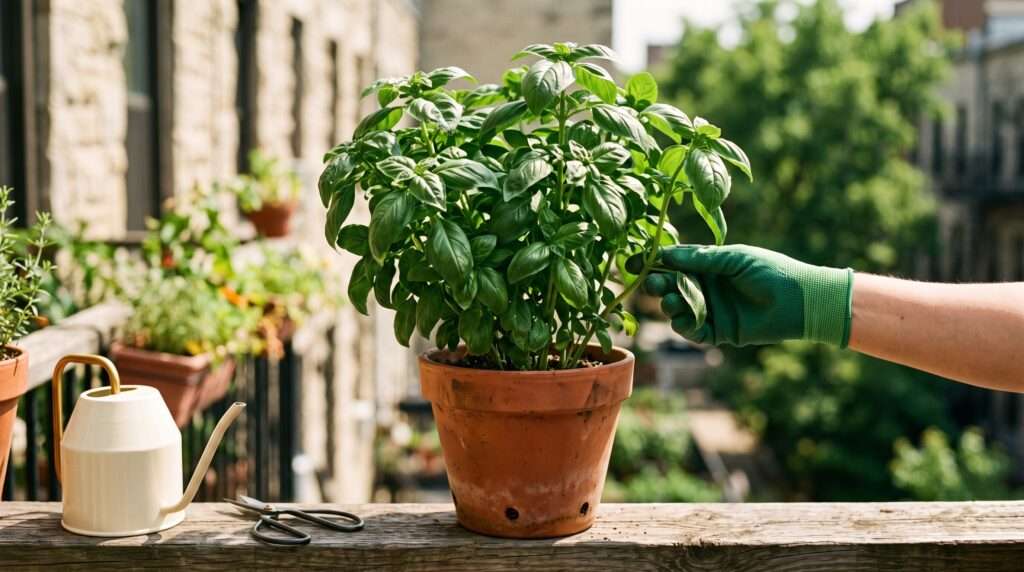
We have all been there. You bring home a lush, perfectly bushy sweet basil plant from the nursery, envisioning a summer filled with fresh pesto and margherita pizzas. But within a month, that beautiful plant has transformed into a sad, spindly, single stem with a few pale leaves clinging to the top. If you are frustrated by these underwhelming results, you are in the right place. Mastering the art of growing herbs in pots doesn’t have to be a mystery. In fact, by applying a few foundational basil container gardening tips, you can stop that leggy growth in its tracks and encourage a massive, bushy canopy.
Over my years of cultivating herbs and dedicating myself to understanding the intricate science of soil health, I’ve learned that leggy growth is a choice, not an inevitable rule. Potted basil (Ocimum basilicum) is incredibly resilient, but it requires a very specific environment to thrive outside of the ground. By tweaking your container setup, optimizing your soil biology, and learning how to prune strategically, you can easily turn a single struggling stem into a high-yielding powerhouse. 🪴✨
Let’s dive into the ultimate guide for keeping your potted basil thriving all season long!
Why Does Potted Basil Get “Leggy” in the First Place? 🪴
Before we can fix the problem, we need to understand the root cause. When we talk about “leggy” basil, we are describing a plant that has stretched upward rapidly, creating long, weak stems with large gaps between the leaves (internodes). This is a sign of stress, not vitality. Here is why it happens:
1. The Struggle for Sunlight (Phototropism) ☀️
Basil is a sun-worshipper. When a plant doesn’t receive adequate light, it triggers a survival mechanism called phototropism. The plant intuitively knows that the sun is “up there,” so it expends all its energy stretching its main stem upward to break through whatever canopy it assumes is shading it. The result is a tall, fragile stem that is desperately seeking UV rays rather than producing the dense, flavorful foliage you actually want to harvest.
2. Incorrect Pruning Practices ✂️
This is arguably the most common mistake beginners make. When it’s time to cook, many gardeners simply pluck the largest, most mature leaves off the sides of the stem. While this gives you a quick garnish, it strips the plant of its solar panels and forces it to continue growing taller from its singular central growing tip (the apical meristem). To get bushy growth, you have to force the plant to branch out—which requires a completely different harvesting technique.
3. Severe Overcrowding in Nursery Pots 🌱
Have you ever noticed that those little grocery store basil pots look incredibly full? That’s because they usually contain 10 to 15 individual seedlings crammed into a tiny 4-inch space. While it looks great on the shelf, it’s a death sentence for long-term growth. As those seedlings grow, their roots choke each other out, and they aggressively compete vertically for light and nutrients. They are literally racing each other to the top, resulting in a cluster of leggy, stressed plants.

7 Expert Basil Container Gardening Tips for Maximum Yield 📈
Now that we know what goes wrong, let’s fix it. Here are the most effective, expert-backed strategies for container-grown basil that produces a massive yield.
1. Don’t Crowd the Roots: Choosing the Perfect Pot Size 🏺
If you want a big plant, you need to provide ample room for a healthy root system. Keeping basil in a tiny pot stunts its growth and leads to rapid nutrient depletion.
-
The Rule of Thumb: For a single basil plant, you should upgrade to an 8-inch to 12-inch wide container. This provides enough volume for the roots to expand and stabilizes the soil temperature.
-
Material Matters: Terracotta pots are fantastic for beginners because the porous clay breathes, allowing excess moisture to evaporate quickly—a huge plus since basil hates sitting in soggy soil. However, if you live in a scorching climate, a plastic or glazed ceramic pot might be better, as they retain moisture longer and prevent the plant from drying out by noon.
-
Drainage is Non-Negotiable: A pot without drainage holes is a bucket, and basil will drown in a bucket. Ensure your chosen container has at least one large drainage hole. If it doesn’t, grab a drill and make some! 🕳️
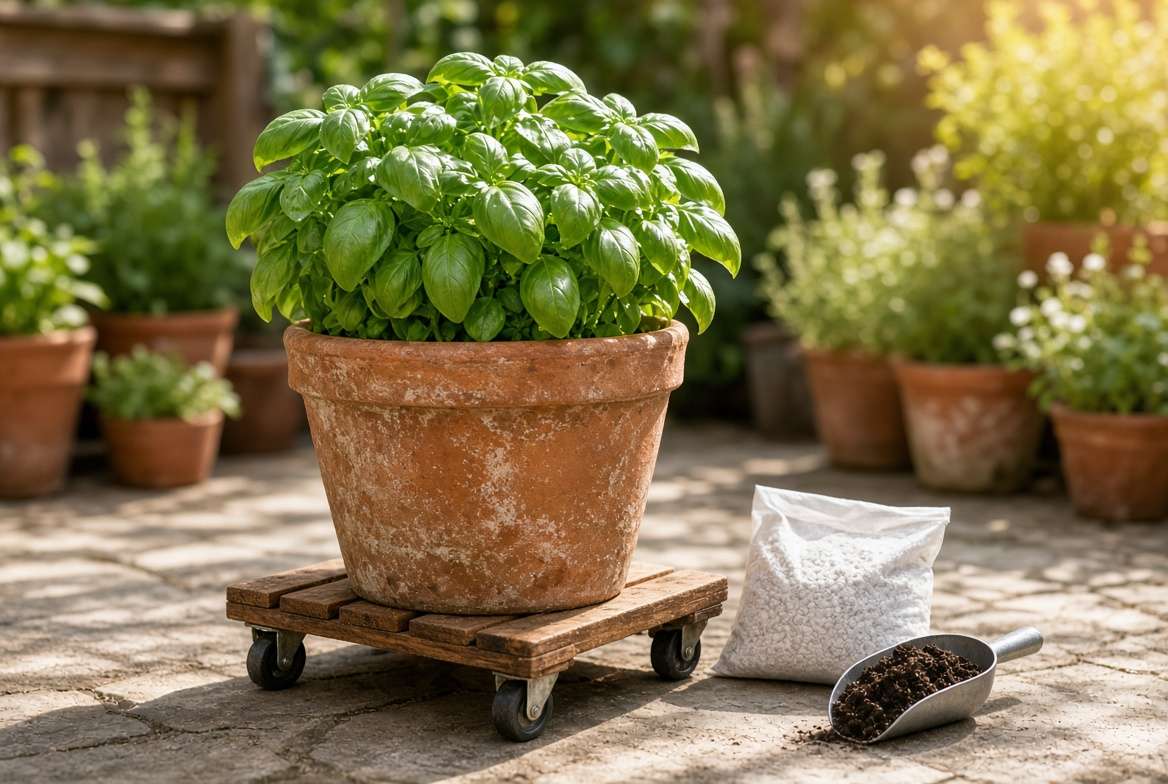
2. Craft the Ultimate High-Drainage, Living Soil Mix 🪱
The secret to a thriving potted herb garden lies entirely in soil health. Standard, heavy garden dirt from your backyard will compact in a container, suffocating the roots and leading to root rot. Even cheap, generic potting soil often lacks the aeration and biological activity necessary for a truly robust plant.
To maximize your yield, you need to create a custom soil profile that balances moisture retention, aggressive drainage, and rich organic nutrition.
The Expert Basil Soil Recipe:
-
50% High-Quality Organic Potting Mix: This acts as your base, providing structure and peat/coco coir for moisture retention.
-
25% Perlite or Pumice: This is the secret to high drainage. These porous rocks create tiny air pockets in the soil, allowing oxygen to reach the roots and excess water to drain away instantly.
-
25% Organic Compost or Earthworm Castings: This introduces beneficial microbes and a slow-release source of organic nitrogen, which is exactly what basil needs to push out brilliant green foliage. 🐛🍂
By fostering a living, well-aerated soil environment, you ensure your basil’s roots are robust, happy, and ready to support massive top growth.
3. The 6-Hour Rule: Mastering Container Placement ☀️
As mentioned earlier, a lack of sunlight is the primary driver of leggy growth. Basil is native to tropical regions in Central Africa and Southeast Asia; it craves warmth and intense light.
-
The Sweet Spot: Your container must be placed in a location that receives a minimum of 6 to 8 hours of direct, unfiltered sunlight every day. South-facing patios or balconies are generally the best spots.
-
Managing Extreme Heat Stress: While basil loves the sun, extreme afternoon heat (temperatures consistently over 90°F / 32°C) can cause the leaves to scorch and the plant to wilt dramatically. In peak summer, the ideal placement offers full morning sun and a bit of dappled, protective shade during the intense late afternoon hours.
-
The Balcony Gardening Hack: Because the sun’s angle shifts throughout the season, consider placing your heavy pots on a rolling caddy. This allows you to effortlessly chase the sun across your deck or pull the plant into the shade during a heatwave. 🛞☀️
4. Master the “Bottom-Up” Watering Technique 💧
Watering seems like the simplest part of gardening, but it is where the majority of container herbs meet their demise. Basil prefers soil that is consistently moist but never soggy.
-
The Risk of Top-Watering: When you pour water forcefully over the top of the plant, soil inevitably splashes up onto the lower leaves. This soil often harbors fungal spores. When combined with the high humidity around the base of the plant, this splashing creates the perfect breeding ground for diseases like Downy Mildew or leaf blight, which can decimate a basil plant in days.
-
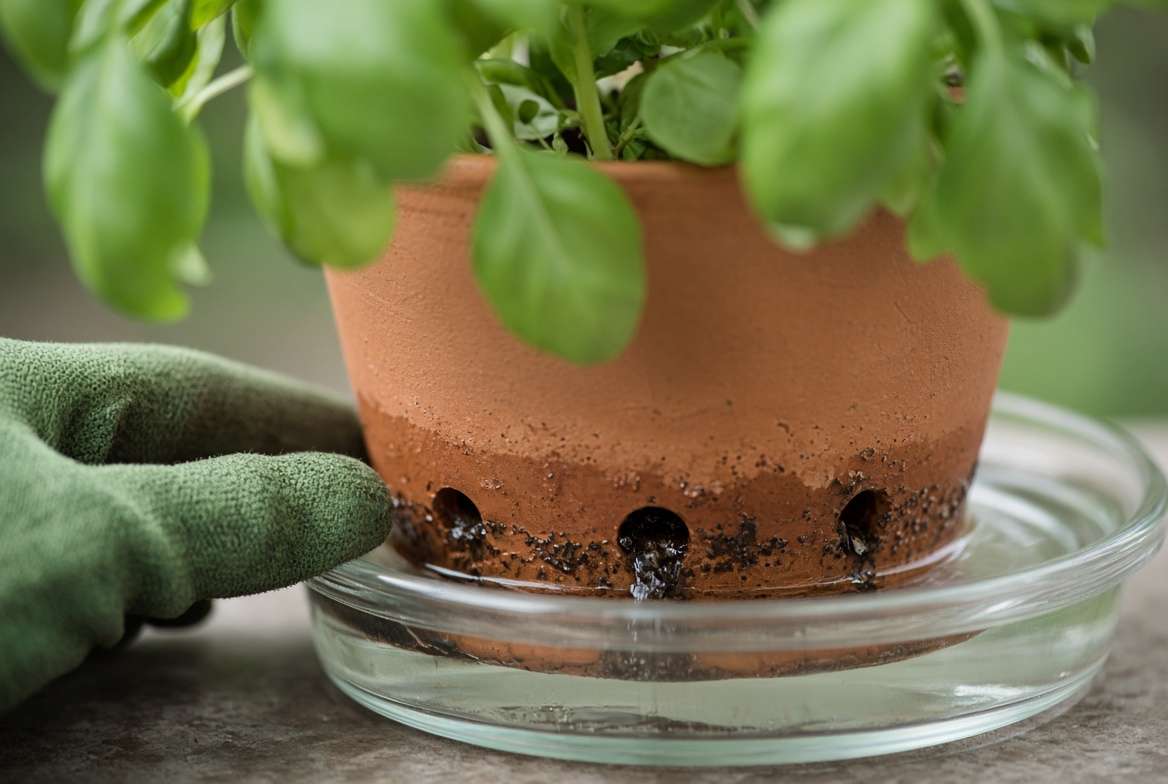
The Bottom-Watering Strategy: To protect the foliage and encourage deep root growth, switch to bottom-watering. Place your nursery pot (with its drainage holes) into a shallow tray or saucer filled with an inch of water. Let it sit for 20 to 30 minutes, allowing the soil to wick the moisture up through capillary action directly to the root zone. Once the top of the soil feels slightly damp, remove the pot from the tray so it doesn’t sit in standing water.
-
The “Finger Test”: Never water on a strict calendar schedule, as evaporation rates change with the weather. Instead, use the simple finger test: press your index finger into the soil up to your second knuckle (about two inches deep). If it feels damp, walk away. If it feels completely dry, it’s time to water. ☝️
5. Pruning is Harvesting: The “Node Pinching” Strategy ✂️
(Expert Note: If you only take away one tip from this entire article, let it be this one. Proper pruning is the ultimate secret to stopping leggy growth and forcing massive, bushy expansion.)
As mentioned earlier, plucking individual leaves off the sides of the stem is a recipe for a tall, weak plant. To create a bushy basil canopy, you must understand how to prune strategically. Every time you harvest, you should be shaping the plant.
The Anatomy of a Basil Plant Take a close look at a basil stem. You will notice that the leaves grow in pairs, opposite each other along the main stalk. The point where these leaves meet the main stem is called a node. If you look closely at that intersection, you will see two tiny, microscopic leaves resting right in the crook between the main stem and the large leaf. These tiny leaves are dormant lateral buds waiting for a signal to grow.
The Hydra Effect (Breaking Apical Dominance) Basil plants naturally exhibit a trait called “apical dominance.” This means the plant funnels all its growth energy into the very top tip of the main stem, suppressing the growth of lower branches. This is why it grows straight up and gets leggy!
However, when you take a clean pair of gardening snips and cut the main stem just above a node, you remove that dominant top tip. Instantly, the plant’s internal hormones shift. The energy is aggressively redirected down into those two tiny, dormant lateral buds at the node you just cut above. Within a week, those two tiny buds will erupt into two brand-new, thick branches.
You cut one stem, and two grow back in its place. Cut those two, and four grow back. Cut those four, and you have eight. It is a biological Hydra! 🐉🌿
When to Start Pruning Do not wait until the plant is a foot tall to start this process. Begin “pinching” (snipping off the top cluster of leaves) when the seedling is about 6 inches tall and has developed 3 or 4 sets of true leaves. Snip the main stem down to the second set of leaves. It feels terrifying to chop the top off your baby plant, but this early aggressive prune builds a sturdy, thick structural base that will support heavy foliage yields all summer long.
6. Feeding Your Herbs: Organic Liquid Fertilizer Strategies 🧪
In a traditional garden bed, roots can stretch for yards to find trace minerals. In a container, the plant only has access to the nutrients within those four walls. Worse yet, every time you water your pot and the excess drains out the bottom, essential nutrients wash away with it.
-
The Nutrient Drain: Potted basil is a heavy feeder, particularly of nitrogen, which fuels rapid, green vegetative growth. If your basil leaves are turning pale green or yellow, it is likely starving.
-
What to Use: Skip the harsh synthetic chemical fertilizers, which can burn delicate container roots and negatively impact the flavor of your edible herbs. Instead, opt for a high-quality organic liquid fertilizer, such as fish emulsion, liquid kelp extract, or compost tea.
-
Frequency: Dilute the liquid fertilizer to half-strength (to avoid overwhelming the plant) and apply it to the soil every 2 to 3 weeks during the active growing season. 🐟🌱
7. Stop the Flowers: Preventing Early Bolting 🌸🚫
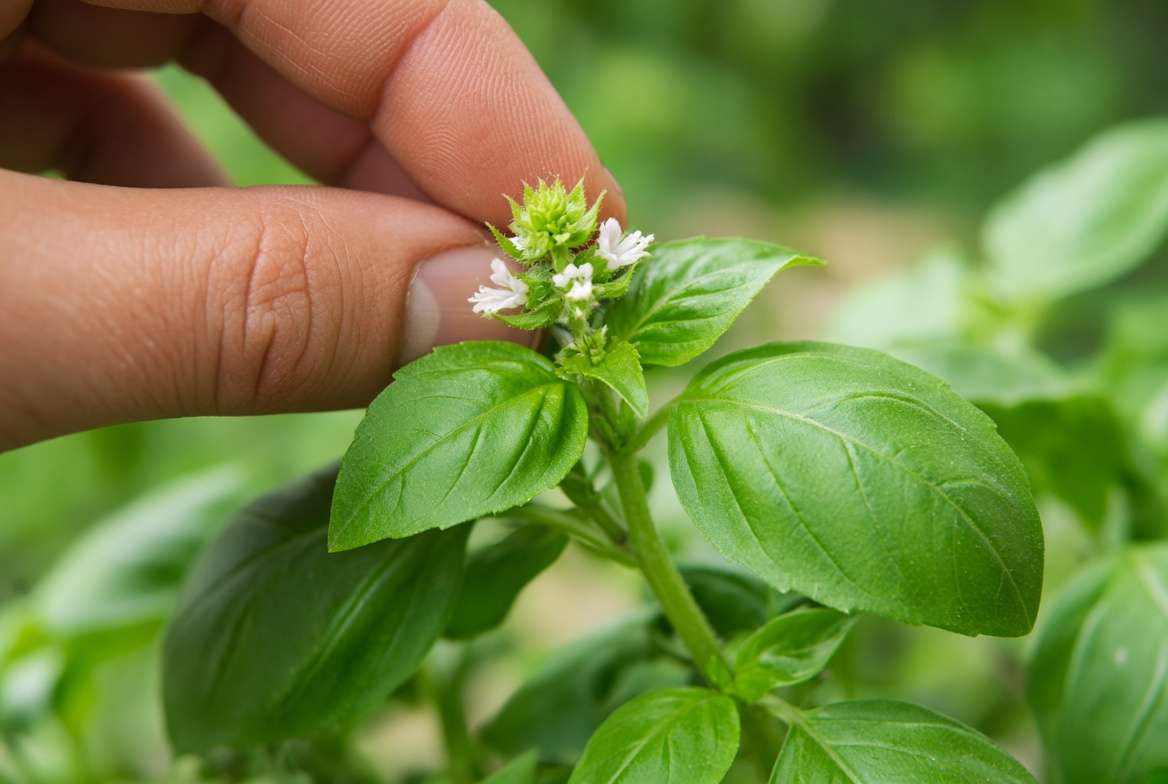
As the summer reaches its peak heat, your basil plant will naturally attempt to fulfill its biological destiny: reproducing. It will start sending up tall, spiky floral structures at the tips of its branches. This process is known as “bolting.”
-
The Flavor Shift: While the tiny white or purple basil flowers are pretty (and pollinators love them!), they spell disaster for your culinary harvest. Once a basil plant shifts its energy from vegetative growth (making leaves) to reproductive growth (making flowers and seeds), the chemical composition of the leaves changes. They often become tough, leathery, and distinctly bitter or woody.
-
Constant Vigilance: To prolong the harvest and keep the leaves tender and sweet, you must practice constant vigilance. Pinch off floral buds the absolute second you see them forming. Do not let them open. By continuously removing the flowers, you trick the plant into staying in its vegetative growth phase for much longer.
Troubleshooting Common Potted Basil Pests 🐛
Even the healthiest container gardens can attract uninvited guests. Because you will be eating these leaves, chemical pesticides are strictly off the table. Here is how to handle the most common intruders naturally:
-
Aphids & Spider Mites: These tiny, sap-sucking insects love the tender new growth of a well-pruned basil plant. If you notice sticky residue on the leaves or fine webbing, you likely have an infestation. The easiest fix is a sharp blast of water from a hose to physically knock them off. For persistent issues, spray the foliage (especially the undersides of the leaves) with organic neem oil or insecticidal soap in the early evening.
-
Fungus Gnats: If you see tiny black flies hovering around the soil surface, you have fungus gnats. These pests lay eggs in damp soil, and their larvae feed on organic matter and delicate root hairs. Their presence is a massive red flag that your soil is retaining too much moisture. Let the top two inches of soil dry out completely between waterings, and consider adding sticky traps to catch the adults. 🪰
Expert Insights: Pro-Tips from the Greenhouse 👨🌾
Want to take your container herb gardening to the absolute next level? Try these advanced techniques:
-
Propagating Free Plants: Remember those thick stems you snipped off during your node pruning? Don’t throw them away! Strip the bottom leaves off a 4-inch cutting and place the stem in a glass of clean water on a sunny windowsill. Change the water every few days. Within two weeks, it will sprout a vigorous white root system. Plant it in potting soil, and you have just created a brand-new basil plant for free! 🌱💧
-
Companion Planting in Large Tubs: If you are growing basil in a large, half-barrel planter, it plays very well with others. Basil is an excellent companion plant for patio tomatoes, as it is believed to improve the flavor of the tomatoes and help deter hornworms. Marigolds are another great addition to the pot to repel nematodes. Never plant basil in the same container as mint, as mint is highly invasive and will quickly choke out the basil roots. 🍅🌼
Frequently Asked Questions (FAQs) ❓
Can I grow container basil indoors year-round? Yes, but a sunny windowsill is rarely enough, especially during the short days of winter. Glass filters out a significant amount of UV light. To grow a bushy, non-leggy basil plant indoors, you will need to supplement it with a high-quality, full-spectrum LED grow light positioned just a few inches above the canopy for 12-14 hours a day.
Why are the bottom leaves of my potted basil turning yellow and falling off? Yellowing lower leaves are typically a classic symptom of poor drainage and overwatering (root rot). However, if your watering habits are perfect, yellowing leaves can also indicate a severe nitrogen deficiency, meaning it is time for a dose of organic liquid fertilizer.
How long does a potted basil plant live? In most climates, sweet basil is treated as a tender annual. It completes its lifecycle in one growing season and will die at the first hint of frost. However, if kept indoors under ideal lighting and temperature conditions, and aggressively pruned to prevent flowering, a single basil plant can be kept alive for over a year, eventually developing a woody, shrub-like stem.
Conclusion & Next Steps 🪴
Transforming a weak, leggy basil plant into a bushy, high-yielding centerpiece for your patio is entirely within your control. By providing a spacious container with rapid drainage, maximizing sunlight exposure, watering from the bottom up, and ruthlessly pinching those nodes, you set the stage for endless harvests. Gardening is an active partnership, and with these basil container gardening tips in your arsenal, you are officially equipped to grow the best herbs on the block.
Now it is time to put these techniques into practice! Go check your basil plant right now—does it need a trim above a node? Go grab your snips! ✂️
We’d love to hear from you: What is your absolute favorite recipe to make when you have a massive basil harvest? Are you team traditional pesto, or do you prefer tossing fresh leaves into a summer salad? Let us know in the comments below! 👇











